

Select one claim that matters
Start with an accessible saved assessment or a published case. This walkthrough uses Assess; sign-in and record access are required there. Public catalogue sources can be inspected in Explore without private assessment access
Pick a claim that could change your decision: a stated benefit, performance level, safeguard or readiness assumption. Bring the underlying source when available, and be prepared to distinguish missing information from contradictory information
Trace the claim in six steps
Define the claim precisely
Write what is claimed, for whom, in what setting and under which conditions. “Enables communication” leaves important questions open about reliability, independence, support and daily use. The illustrative communication-at-home question does not establish any of those outcomes
Identify the kind of input
Distinguish a documented fact, a self-reported claim, a model input, an assumption, a requirement and a missing value. A recorded or simulated data source is a feature of the study description; entering it does not independently verify the study
Read the source in context
Check whether the source concerns the same system, population, setting and outcome. Look at dates and the difference between planned work and reported results. Evidence supporting a narrow test should not silently become a claim about general use
Inspect the reasoning around the result
Where the model applies, read Decision Surface drivers, uncertainty and evidence gaps together. Numerical summaries depend on the entered information and the model. An unavailable numerical output for a dataset study is a scope boundary, not a negative finding
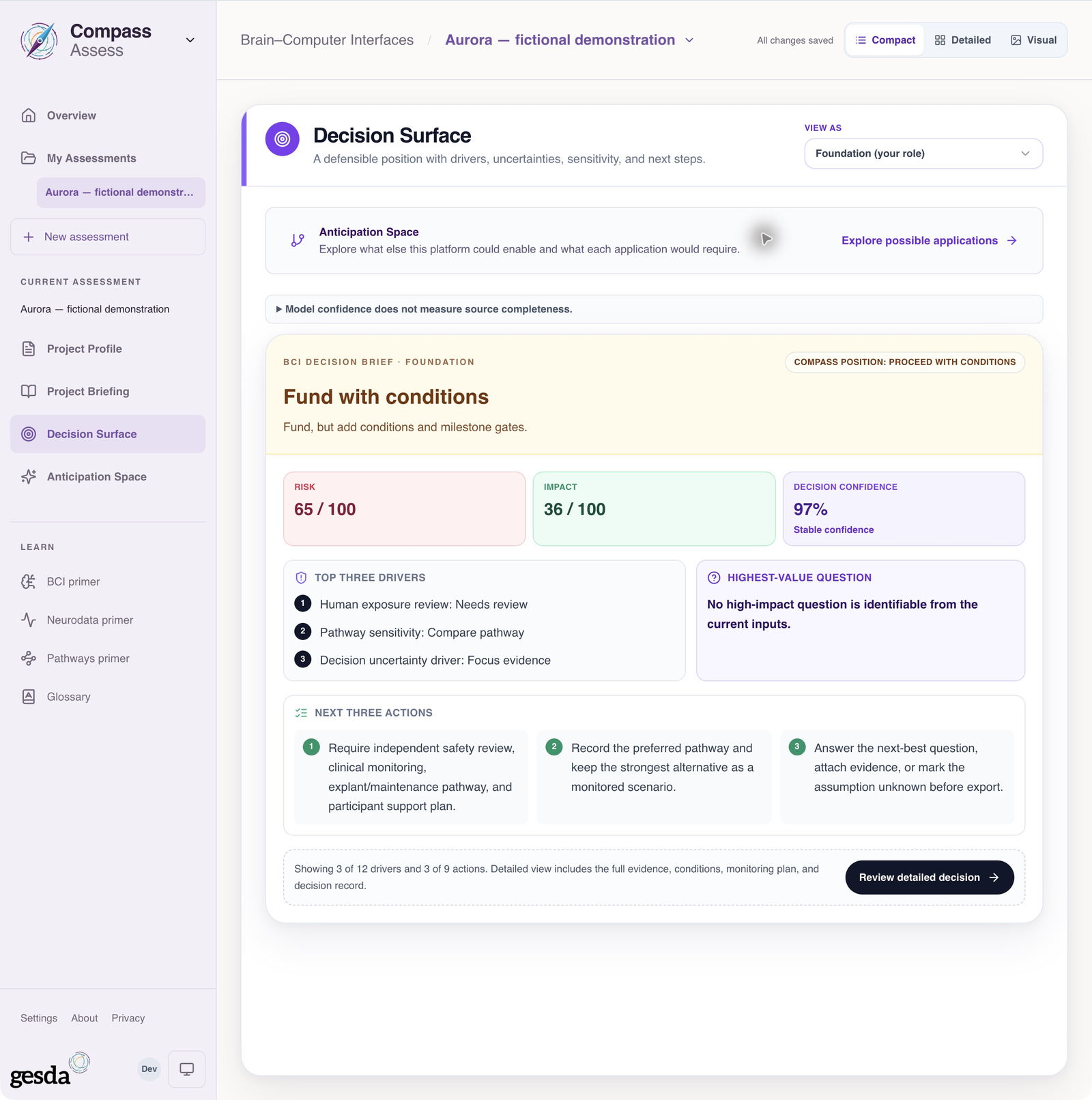
Local documentation capture, 2 October 2026. Fictional Aurora demonstration: inputs, evidence and outputs are illustrative. This is a separate example from the communication-at-home scenario in these guides. Ask which assumption could change the decision
Use supported stress-test controls where relevant, and record the assumption varied and the result you observed. Treat a scenario as conditional reasoning; it does not establish the probability of that scenario. The exploratory Impact map likewise leaves likelihood unestimated
Form an evidence request or condition
State exactly what would resolve the uncertainty: a source, test, population, outcome, safeguard or review. Identify what remains unresolved even if the requested evidence arrives. Use the result to improve the assessment or your own review record
Separate support from certainty
A useful interpretation explains which claim is supported, at what scope, by which source and with what remaining uncertainty. Avoid turning a range into a guarantee or the absence of a documented harm into evidence that harm cannot occur
Use the method for the wider reasoning framework, or continue to Prepare a Passport to carry the evidence and qualifications into a discussion
About this guide edition
Reviewed 2 October 2026 against the current interface and maintained product guide. Screenshots show either the public GESDA catalogue or a local demonstration using fictional Aurora data, as identified in each caption
Local captures illustrate the interface, not sign-in, server persistence or successful export. Use Print / save PDF for a reading copy and follow the live application for current availability
Guide edition · 2 October 2026
Find a guide for your role