Less time getting equipment ready would leave more time for therapy. Easier operation could give people greater freedom to practise. Faster recovery could mean returning sooner to activities that matter to them. But those gains depend on how we achieve them. Reducing help with equipment is different from reducing a therapist’s guidance. A program intended to accelerate recovery through daily practice could also require daily assistance from a family member. The target may sound better while the resulting arrangement becomes harder to live with.
An improvement therefore needs two tests: does it deliver the intended gain, and does it preserve what makes rehabilitation workable and worthwhile for the people involved?
For instance, seven of eight participants completed a home-rehabilitation study using a brain–computer interface. Yet two said that using it daily would be problematic, even though a few sessions a week would be acceptable. The difficulty was the electrode gel: washing it out took time, particularly for people who needed help showering. These findings appear together in a 2025 study of Tele BCI-FES.
Now imagine a team proposing daily practice in pursuit of greater benefit. With the preparation process unchanged, the same device would make more frequent demands on participants and anyone helping them. The original completion result would not establish whether that new commitment was workable. This is a possible next direction, not a daily-use result from the study.
The previous article proposed principles for responsible BCI governance. Here, three studies of different stroke-rehabilitation technologies — not competing versions of one device — help turn them into a practical question: what should the next improvement change, and what must it preserve?
More practice changes the commitment
The study “Tele BCI-FES” used brain signals associated with attempted hand movement to trigger electrical stimulation. The home programme involved nine rehabilitation sessions, three a week, with caregiver assistance and remote research-team support. Completion meant attending at least seven sessions. Participants and caregivers generally considered the system worthwhile despite its setup requirements. This was a small, single-arm feasibility study, not a test of long-term adoption or comparative effectiveness. Mansour and colleagues report the protocol and findings here.
The proposed change is frequency. What changes with it is the recurrence of every task needed to make a session possible. A tolerable commitment on three days of the week might be difficult every day, even if no individual session becomes longer. Measuring preparation in minutes per session would miss that change unless the study also examined the repeated commitment and whose time it required.
This makes keeping findings connected to their conditions more than a rule about cautious interpretation. Those conditions tell a team what its proposed improvement may change. In this case, the schedule is part of what people found workable. Keep the device unchanged and change the schedule, and the practical question opens again.
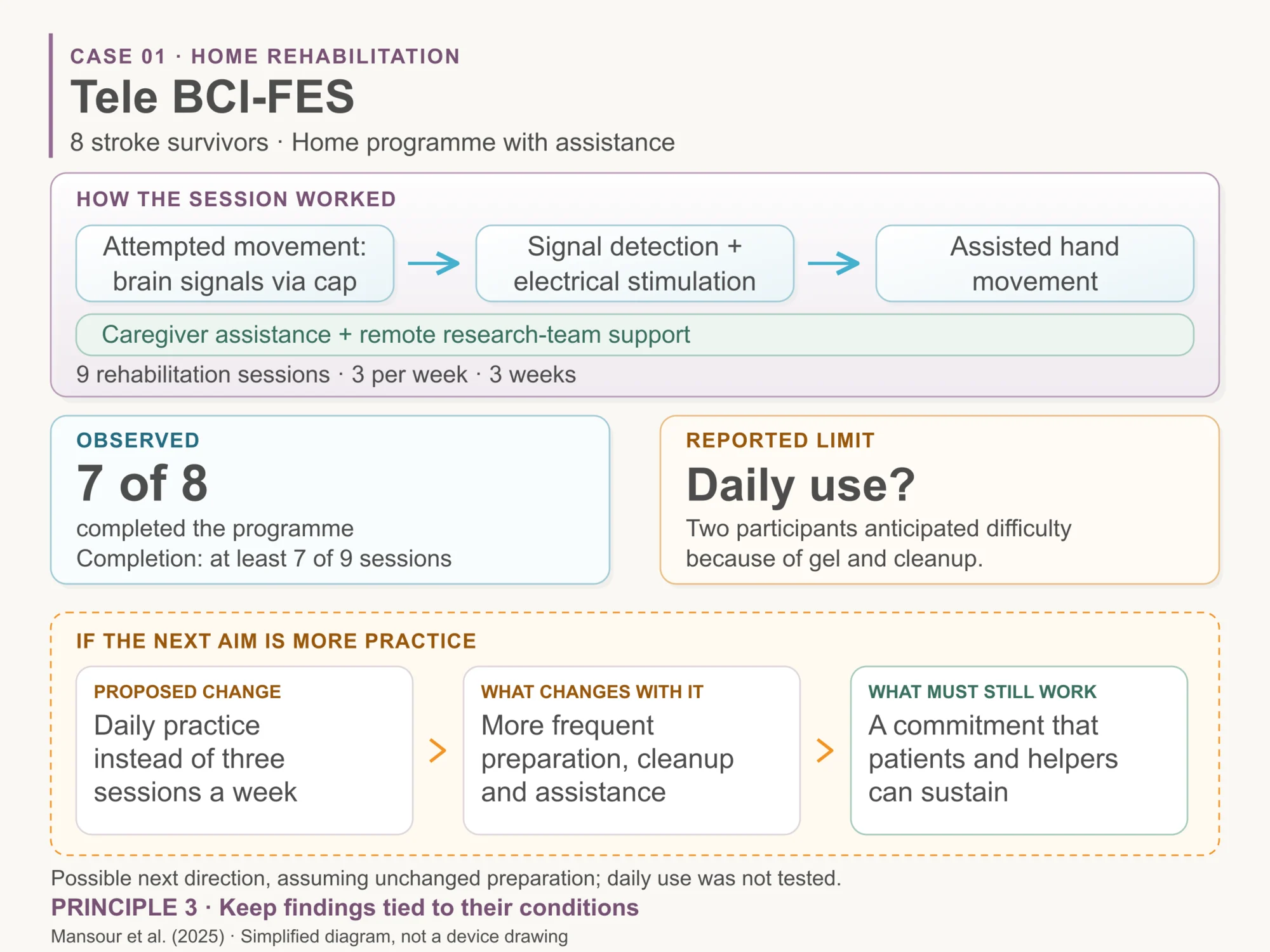
What must still work is the whole commitment: preparation, useful rehabilitation, cleanup, and assistance that people can actually obtain. The researchers made the difficulty visible. A next investigation could ask whether more frequent use becomes workable through a different preparation process or support arrangement, and whether it brings enough benefit to justify its additional demands. Completion of the original programme cannot answer either question on its own.
Greater independence can change the support
When faced with complex equipment that needs support specialists, a natural response is to simplify the setup. That could reduce a real constraint, but before treating assistance as something to eliminate, we need to distinguish the work required by the device from the support that makes rehabilitation valuable.
In a 2023 user-centred study of “exciteBCI”, brain signals were paired with electrical stimulation during movement rehabilitation. Its “repeated-use” phase involved two stroke survivors, one physiotherapist, and 8x 1-hour sessions over 3 weeks. Approximately 10 minutes per session went to putting on and removing equipment. Participants in that phase described benefits they felt outweighed the inconvenience of gel. Across the study, participants also valued the therapist’s guidance and feedback. These were accounts from a small design study, not proof of superior treatment outcomes.
10 minutes is less than 20% of each session. Calling it wasted time would already contain a judgment about what the session gives in return. Participants’ willingness to accept the inconvenience does not remove the case for reducing it. It does, however, warn against defining progress solely by the demand reduced.
Suppose the next aim is greater independence from a physiotherapist. There are at least two changes hidden inside that phrase. One is needing less help to put on and operate equipment. Another is having less professional guidance and feedback during rehabilitation. Success at the first does not establish that the second would be welcome. If a redesign or service change reduced both, it might remove something participants valued while meeting its independence target. That is a possibility to investigate, not an adverse outcome documented by this study.
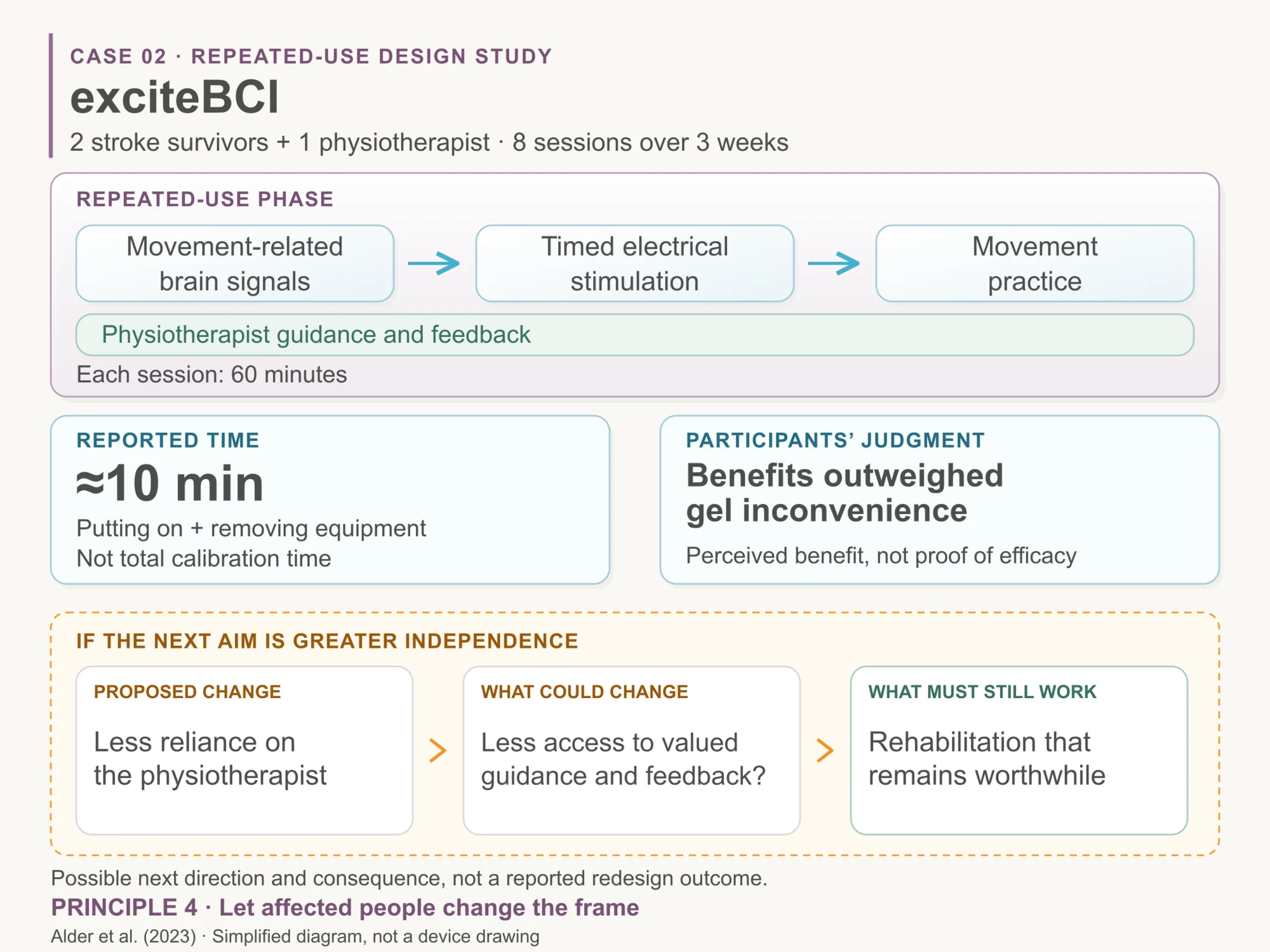
Therefore, a useful development question is more specific: which forms of help could become unnecessary, and which should remain available? A person might want easier equipment and continued guidance. Letting affected people change the frame means allowing that distinction to alter the target before the design is fixed. Independence should not quietly become a proxy for being left to manage alone.
What must still work is rehabilitation that people find worthwhile, with the support it requires. Their judgments help define that question; they do not substitute for evidence that the treatment works. Nor should we expect the patient, caregiver, and therapist to value every form of assistance in the same way.
Design for the session you have
The first two cases helped identify what a next change could disturb. The third one now offers a constructive response: make the practical requirement part of the experiment from the start, so that preparation and useful activity are assessed together.
In a pilot reported by Annalisa Colucci and colleagues, five stroke survivors undergoing inpatient rehabilitation tested a portable hand exoskeleton controlled through brain and eye signals. Each took part in a 1-hour session. Setup and calibration took less than twenty minutes, and all five performed a battery of ten everyday activities requiring both hands. The authors explicitly treated the available 45–60-minute therapy window as a design constraint. The pilot demonstrated bounded feasibility; it did not establish sustained clinical use or lasting rehabilitation benefit.
The target was to make the capability usable within the available appointment. That changes the test: getting the system ready belongs inside the assessment alongside controlling it and performing the activities. A preparation-time result alone would leave the useful activity unexamined; a task-performance result alone would leave open whether getting ready consumed the opportunity to use it.
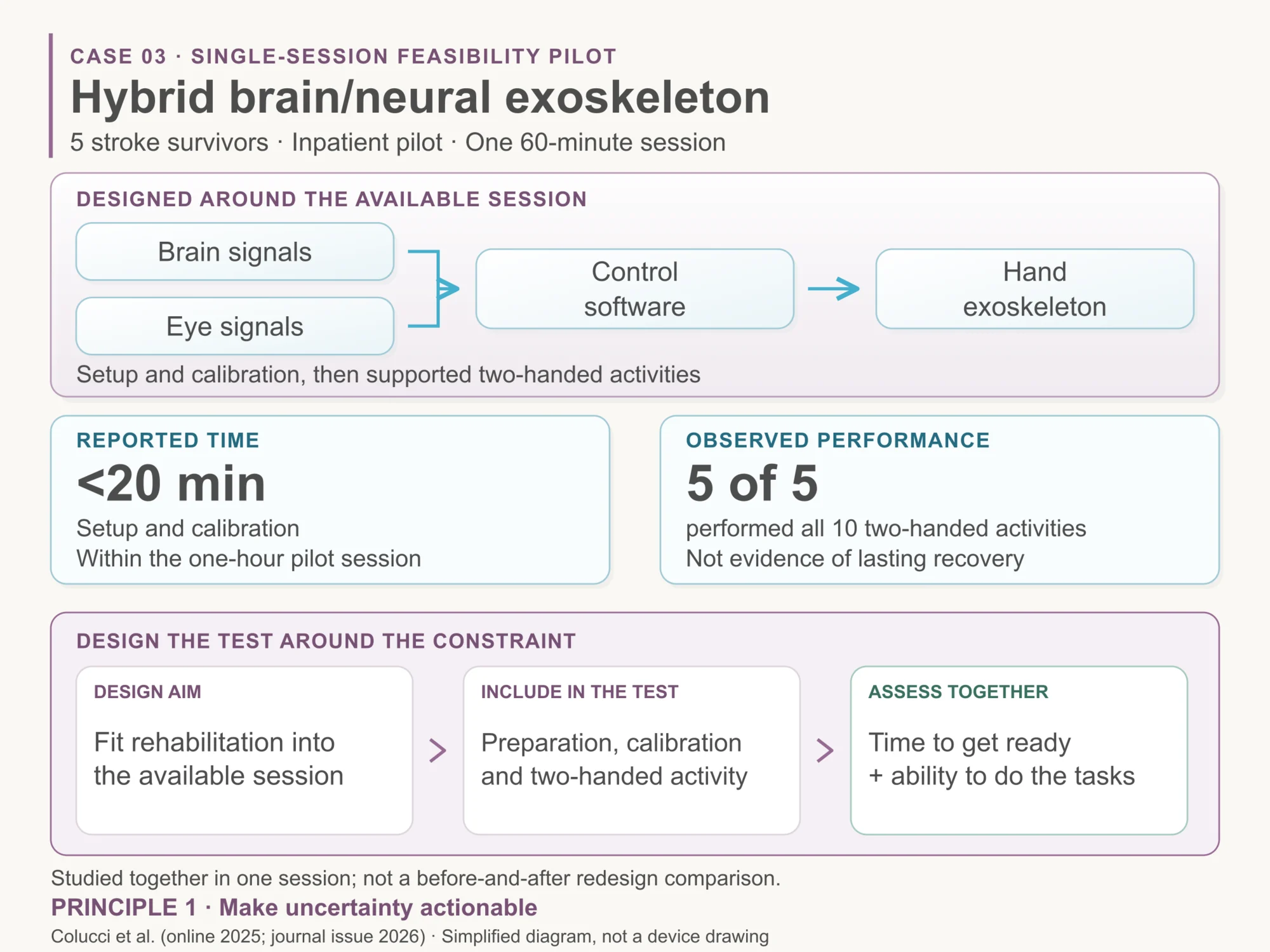
This is what the other cases point towards: 1. Name the intended gain, 2. identify the conditions it depends on, and 3. assess them together.
Here, the researchers brought the time constraint into the design rather than leaving it as a general reservation about future use. The pilot does not show that a redesign improved on an earlier version. It shows a way to formulate a more useful feasibility question.
Making uncertainty actionable, in the terms of the design principles, means specifying what the available time must accommodate. Repeated visits and different support needs would require further investigation, but the single-session result already addresses the relationship between preparation and practical use.
Nor does the timing rank this system against “exciteBCI”. Putting equipment on and taking it off is a different measure from setup and calibration. The tasks and technologies also differ. Their value here is as examples of how to formulate a question, not as a league table of faster devices.
What the five principles help us do
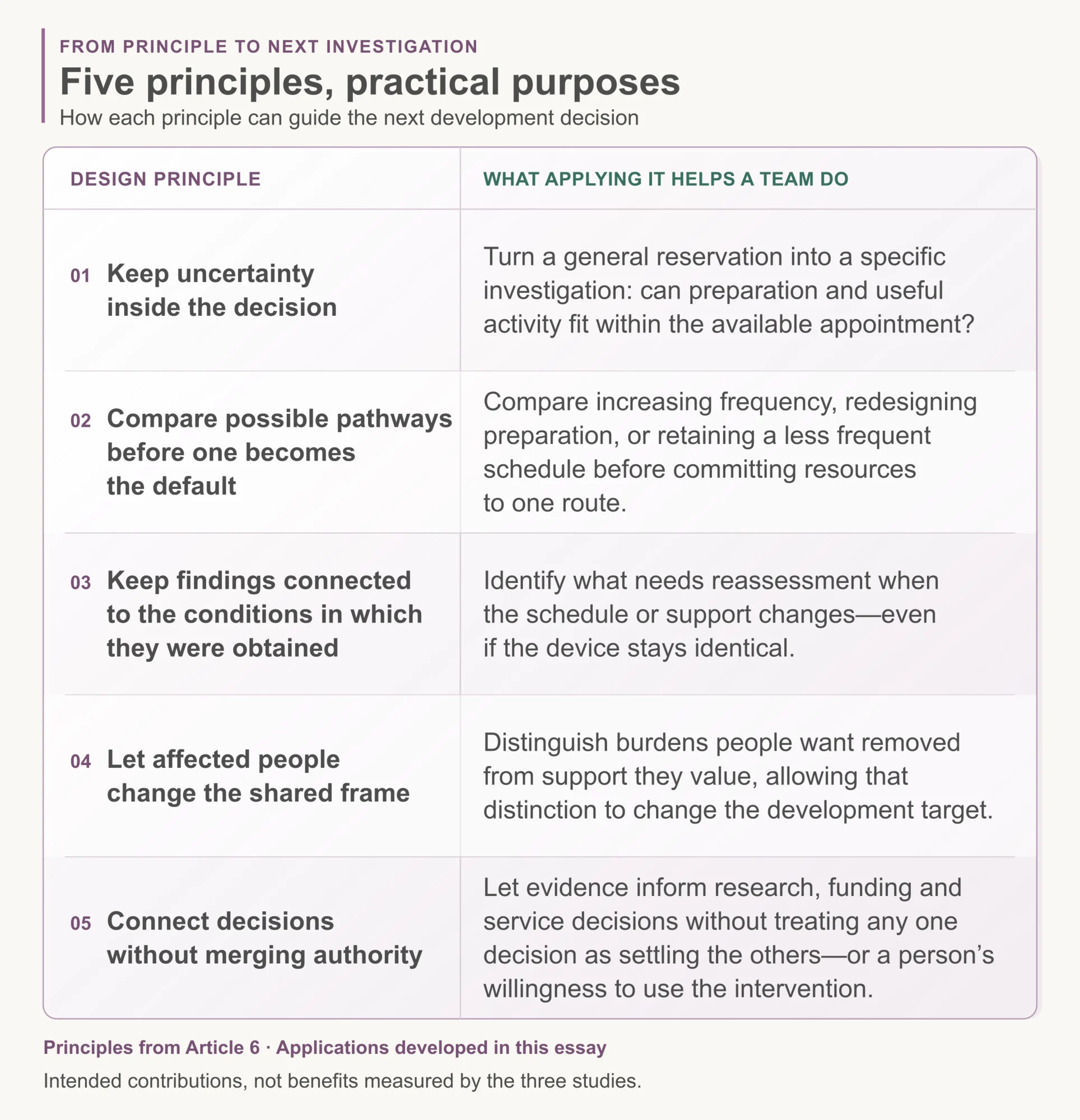
The five principles from the previous article acquire a practical purpose here. They help a team identify what to investigate, which alternatives remain open, what the evidence supports, whose experience should change the target, and who must decide what follows.
Give an improvement two tests
An intended improvement should be assessed both for the gain it achieves and for the conditions of usefulness it changes. More frequent practice would need evidence about benefit and the recurring commitment. Less equipment dependence would need assessment alongside the support still wanted or required. Fitting an appointment means examining getting ready and doing something useful within it.
This is why quantifying burden matters. For a proposal to increase frequency, minutes per session would be only the beginning. Preparation, calibration, treatment, troubleshooting, and cleanup would need to be distinguished across the proposed schedule. Patient time and caregiver time should remain separately visible, along with tasks requiring a clinician or technical specialist. Otherwise, an apparent improvement could consist partly of moving work to someone whose contribution was not counted.
An average could conceal sessions requiring substantial help, or people for whom the process was consistently harder. The spread of times, interruptions, and sessions that could not proceed would help a team plan the support needed. Following burdens over time would also distinguish initial learning demands from recurring work.
The benefit side needs equal care. A faster process matters because of what the saved time or effort makes possible: more useful activity, a manageable commitment, or less need to arrange help. Measuring that consequence would tell us more than recording a shorter setup alone.
These observations do not give us a general price for BCI translation or establish how often practical constraints are discovered too late. They show researchers investigating practical use alongside technical capability. The lesson is to build on that work, not attribute a failure of coordination to it.
Turn a limit into a next investigation
Return to the hypothetical daily-use proposal. The cases suggest a choice before the team settles on its next performance target.
The first decision should concern the alternatives. The team could investigate the more frequent schedule with the existing preparation process, redesign preparation first, or continue examining a less frequent arrangement. Those routes make different demands and leave different uncertainties. Comparing them gives practical content to the principle of examining possible pathways before one becomes the assumed future.
If reducing preparation appears worth pursuing, the study question should specify what must be preserved. A quicker process would need assessment alongside reliable operation, usable rehabilitation time, and participants’ experience. The team should also ask whether the proposed change helps people who need more assistance, rather than achieving a better average by testing only those for whom the process is easiest.
Patients and caregivers should help define what would count as a tolerable repeated commitment before the team fixes the evaluation. Clinicians should specify what the proposed service can actually provide. The research team can then design an appropriately reviewed investigation that tests the uncertainty most relevant to that proposal. This is an illustrative research direction, not a prescribed treatment schedule.
Before beginning, the team could write a short account of what the current evidence supports, what it proposes to change, and which findings would justify continuing, revising, or stopping that route. It should identify who can undertake the work and who will reconsider the proposal when results arrive. That gives an evidence gap a purpose and a responsible next step.
Separate decisions remain necessary. Funding an investigation does not establish that its eventual intervention should be offered as a service. A service provider’s ability to offer it does not establish that a particular person finds it worthwhile. Connecting the evidence helps each decision without requiring a shared verdict.
What a better result would let us say
The strongest next result would let a team say more than “the device improved.” It would show what became possible as a result, under which conditions, and with which demands on the people involved. A shorter setup could make a schedule manageable. Easier equipment could reduce unwanted dependence while preserving valued guidance. A capability could become usable within a real appointment.
The three studies do not document improvements that subsequently went wrong. They give us grounds for asking a better question before pursuing the next one. A practical constraint can change which route is worth investigating; a participant’s judgment can change what that route should preserve. This is how the principles from Article 6 become design choices, rather than qualifications added to a promising result.
Return to the person who could accept several sessions a week but anticipated difficulty with daily use. The aim is not to persuade them that more practice must be better. It is to find out whether a different preparation process, schedule, or support arrangement could offer greater benefit on terms they can sustain. An improvement becomes useful when it improves that possibility and not merely the number the team set out to change.