A person considering a brain–computer interface for rehabilitation needs to understand what it could make possible and what using it would demand. On the other hand, a researcher planning the next development phase needs to decide what to investigate. From another different perspective, a patient organisation may want to know whether the needs its members describe are being addressed anywhere at all.
Giving all three access to the same collection of papers would help. But it would not, on its own, give them a way to do those different things, nor connect and reconcile what they discover.
Consider someone who wants more opportunity to train without more journeys to a clinic. A proposed home-rehabilitation schedule could serve that goal, but it would require help every day, and not everyone has a family member that can provide additional visits. Such a caregiver limit does not establish that the technology is ineffective. It does, however, challenge an assumption about how this particular arrangement would work. A simple way to add value in this case is bringing both the person’s goal and the caregiver’s constraint into a single view.
This is an illustrative situation, but the underlying tension is real. In a small home-rehabilitation study of a brain–computer interface, seven of eight participants completed the programme. Two nevertheless anticipated difficulty with daily use because of electrode-gel cleanup, especially when showering required help. Completing a study and willingness to use a system more frequently answer different questions.
The previous article drew a practical lesson from this and two other studies: an improvement should be assessed both for its intended gain and for the conditions it changes. More practice may change the commitment, easier equipment should not inadvertently remove valued guidance, and promising capability still has to fit into the time available to use it.
These examples show why the five design principles for responsible BCI governance matter. But what would an actual solution look like? A useful starting point is the fifth principle: Connect decisions, preserve distinct responsibilities, and expose gaps in collective authority.
In the home-rehabilitation example, the person’s goal should help shape what the research team investigates. The caregiver’s limit should change what the team assumes about daily support. Neither contribution establishes whether the approach is clinically appropriate or commits a funder to paying for assistance. But those decisions need to inform one another while remaining with the people responsible for them. If nobody has committed to providing necessary support, the arrangement remains unresolved. And if none of the organisations involved has the authority to secure that support, documenting the gap cannot, by itself, close it.
Read this way, the 5th principle gives a collective solution its organising structure. The other four specify how it must work. Affected people must be able to shape the goals and acceptable burdens, not simply comment on choices already made. Evidence must retain the conditions under which it was obtained, so a result from an assisted programme does not become a promise of independent use. Alternative pathways must remain open to comparison, and uncertainty must stay visible — including whether further investigation could still change the course. This is an order for designing a solution, not a ranking of the principles’ importance.
The practical question, then, is what different people need to be able to do and how their work can help someone else reconsider a decision. Some need to explore possibilities; others need to examine a particular rehabilitation plan, look across projects or improve the knowledge others rely on. A solution would support those different activities while allowing a goal, a constraint or a correction to inform the next person’s work without losing its meaning.
Let’s follow an example starting from the patient’s perspective to see what an ideal solution would need to help each person do.
Start with what you want to make possible
Imagine that you are recovering from a stroke and have read about BCI-assisted rehabilitation. Before comparing devices, you may want to understand whether anything in this field could help you pursue a goal that matters to you. Perhaps you want to regain the use of a hand for everyday activities, practise without travelling as often, or depend less on someone else to organise each session.
Those goals can lead in different directions. Practising at home might reduce travel while increasing the help needed there. Equipment that is easier to operate might make a session more manageable without changing how often professional guidance is wanted. An approach that does not use a BCI may also deserve consideration.
A useful interface for this work would begin with the goal and the circumstances, rather than require you to choose a technology or understand its technical categories. It would help you describe what matters, what you can already do, what support is available and what you would not want to give up. You should be able to revise those answers as you learn, or leave a question unanswered without being pushed towards a result.
It could then place relevant possibilities beside one another: what each is intended to make possible, what people would need to do to use it, what has actually been studied and what remains uncertain. Research-stage possibilities would be clearly distinguished from available care. Plain-language accounts would lead back to their sources, with clinical questions taken to an appropriate professional rather than answered by an automated match.
The useful outcome might be quite modest: a clearer goal, two alternatives worth discussing and a requirement that any proposal must address. In our example, that requirement could be to avoid relying on additional unpaid visits. The person seeking rehabilitation and the caregiver would be able to express different wishes and limits; one should not be made to speak for the other.
They should also be able to check how their contributions have been recorded. Wanting less help with equipment is not necessarily wanting less contact with a therapist. If a summary merges those ideas, the person needs a way to correct it before deciding whether to share it.
This gives exploration a purpose beyond learning about a field. Someone can leave with a question they are better able to put to a clinician, researcher or service provider. They can also decide that the possibilities described are not worth pursuing for them. Neither outcome requires completing an assessment of a device.

Examine what a proposal would actually require
Now imagine working on the next version of a home-rehabilitation project. You have a proposed improvement, some evidence and several choices about what to investigate next. A general introduction to BCIs will not tell you whether the evidence supports your proposal or whether its assumptions fit the people and setting you have in mind.
The most useful interface here would put the proposal beside the evidence and the conditions it depends on. What benefit is being sought? What would change from the arrangement already studied? Which claims have direct support, and which are expectations to test? What assistance, equipment, time and professional input would the proposed arrangement require?
For the hypothetical daily schedule, the distinction between a studied schedule and a proposed one should be visible where the claim is made. The reader should not have to search a footnote to discover that a completion result came from different conditions. Nor should an empty field for caregiver time look like evidence that no assistance was needed.
The requirement from our earlier exploration could now do real work, if its authors chose to share it. Placed beside the proposed schedule, it would expose a mismatch: the plan assumes additional help that is not available in this household. The team would need to consider a different support arrangement, a preparation redesign or another route worth investigating. It could also explain that it cannot yet meet the requirement. What matters is that the response is visible and can be questioned.
For example, moving sessions back to a clinic might remove the need for those home visits. But the person seeking rehabilitation could point out that it would restore the travel they wanted to avoid. Keeping their goal beside the proposed response would prevent one solved problem from concealing another. The next investigation might then concern whether a preparation change could preserve home use while reducing the help required.
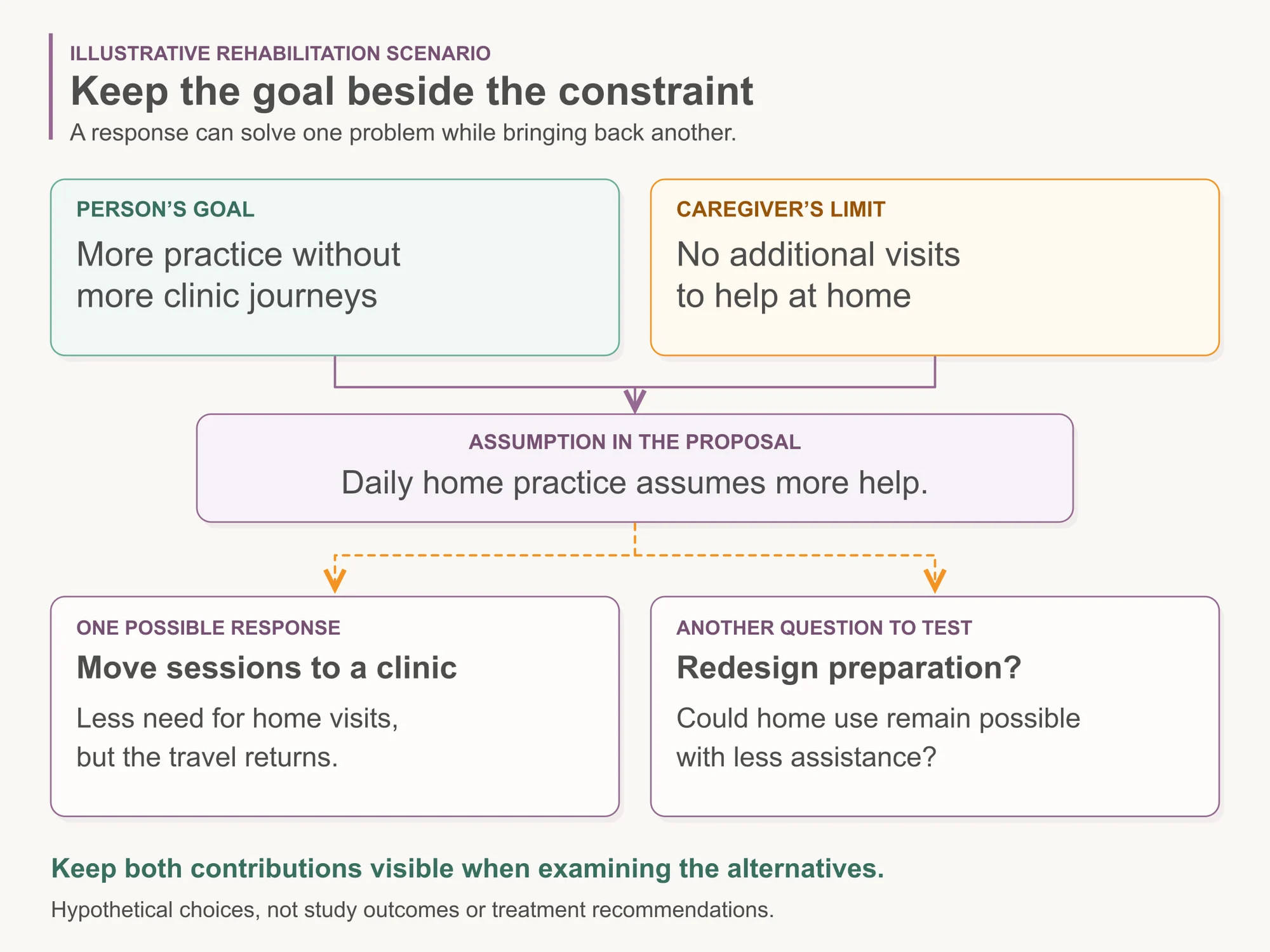
This would be a place to compare those alternatives, inspect their supporting sources and record what remains unresolved. An output could distinguish what the evidence currently supports, what the proposal adds and what would need to be investigated before taking it further. It would be a working assessment, open to revision, rather than a score that appears to settle the question.
Different people could use that assessment for different purposes. A developer might identify a design problem. A clinician might challenge a support assumption. The person considering participation might check whether the proposed benefit still matches their goal. A funder might ask why a study budget omits the assistance on which participation depends.
They would not need to reach one verdict. A proposal can be worth researching without being ready to offer as a service, and a service can be available without being acceptable to a particular person. The interface should make the reasons for those judgments easier to inspect, while leaving each decision with the people responsible for it.
Look beyond the project in front of you
A patient organisation may have a different task. Its members have raised questions about the help needed to use rehabilitation technologies at home. It wants to know whether research is addressing those questions, which kinds of support are being considered and where to direct its own advocacy or research partnership efforts.
Opening one project after another might produce useful examples. To investigate a pattern, however, the organisation needs to see a defined collection and understand what can fairly be compared within it.
A useful interface would let someone choose the relevant population, purpose and use setting, then inspect how the included records describe assistance, preparation and follow-up. It would make the collection’s boundaries visible: which sources were included, how recently they were checked and where information was missing. A comparison would retain the distinction between different measures, such as time spent fitting equipment and total time spent preparing for a session.
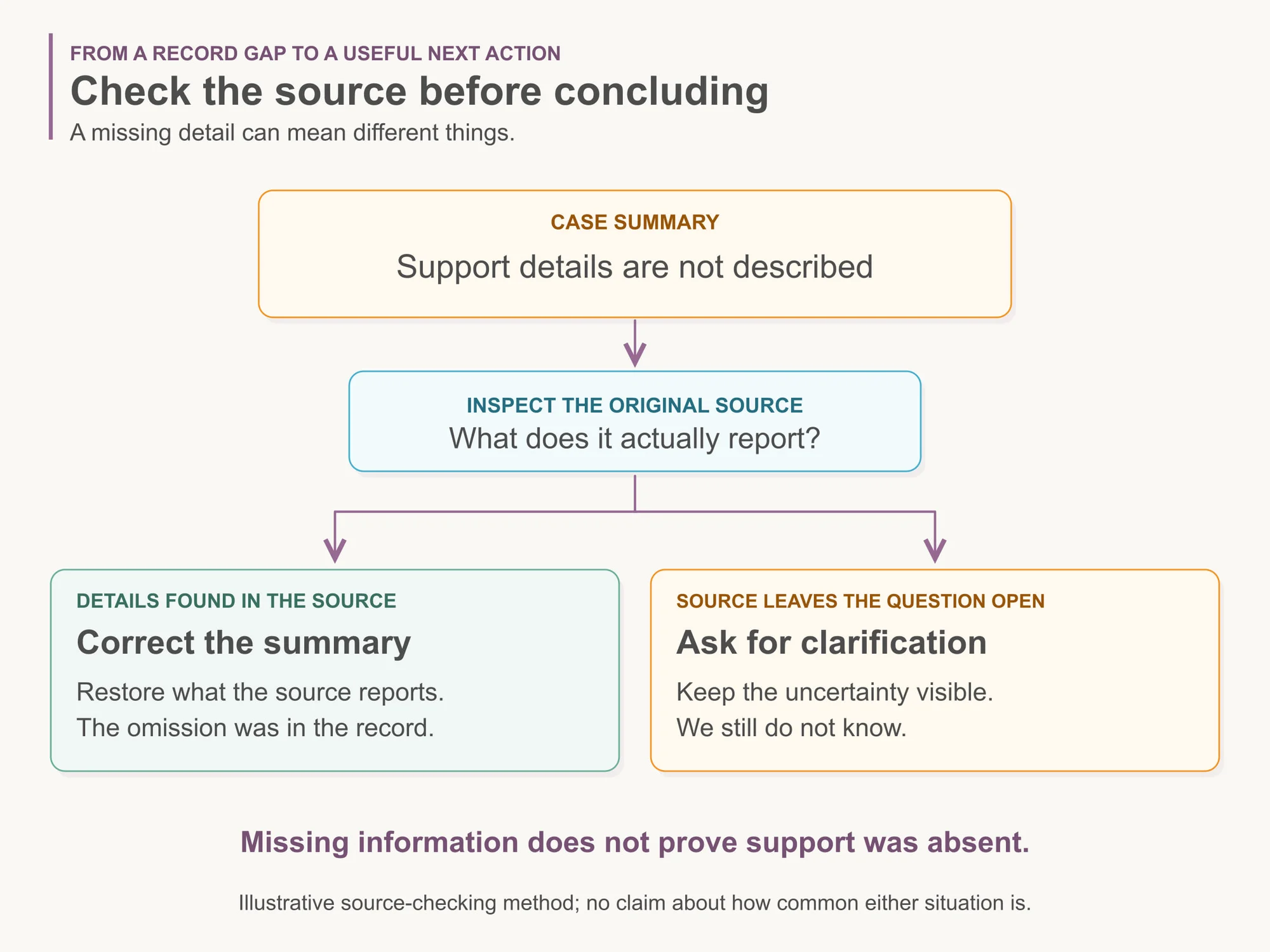
The organisation could begin by separating records that describe the assistance required from those where that information is missing. Opening a source might reveal that the paper contains details its summary omitted. That record would need correcting. Where the source itself left the question open, the organisation could request clarification. It would leave with a more precise distinction between what was known, what had been poorly summarised and what still needed asking.
Every apparent pattern would need this route back to the cases behind it. If support arrangements remained unclear in several records, the immediate finding would concern what those records disclose. It would not establish that support was absent, that researchers ignored it or that the entire field had the same gap.
Even that narrower finding could be useful. The organisation could identify a question for researchers, seek fuller information or argue that future studies should make particular support requirements easier to understand. A funder examining an authorised portfolio could use a similar approach to ask whether a recurring uncertainty merits a dedicated investigation. Neither needs a league table declaring which BCI is best.
This is a different task from judging one proposal. It helps people decide where to look, whom to approach and which questions deserve more attention. The value lies in making the basis for those choices inspectable, including the limits of the collection.
Make the shared account correctable
All of these activities depend on how knowledge is represented. A plain-language case description, a comparison or a summary beside a proposal can become misleading even when the underlying paper is sound.
Suppose a case summary described a system as suitable for daily independent use, but its source only supported feasibility under a less frequent, assisted arrangement. A reader should be able to point to the disputed claim and its source, explain the problem and request a correction. Adding a general comment at the bottom of a page would leave the misleading claim intact.
The people maintaining the collection would need their own way to examine the issue: the current wording, the proposed correction, the relevant evidence and the reason for changing — or retaining — the account. Readers should be able to see whether a correction is pending, what was changed and which version they are consulting. Genuine disagreement may need to remain visible rather than disappear into one polished sentence.

Correcting the daily-use claim would have an immediate practical consequence. Someone comparing home-rehabilitation possibilities could see that this example did not yet answer their question about managing a daily schedule without help. They could investigate that uncertainty rather than mistake the summary for an answer.
That work is curation: deciding how a claim should be represented, with what support and qualifications, and keeping that representation open to revision. It is not the same as approving a technology or deciding whose goals are legitimate. A maintainer can check whether a summary accurately describes a study; they cannot resolve a person’s unwillingness to accept a burden by editing it away.
An affected person should likewise be able to challenge how their own contribution has been summarised. Their account of needing assistance and a study’s measured outcome are different kinds of information. Both can matter without being made interchangeable. Keeping that distinction clear is part of making knowledge useful, not an obstacle to sharing it.
Let a contribution change the next person’s work
These activities should not become separate territories assigned to different professions. A researcher can start by exploring an unmet need. A patient organisation can examine a proposal or investigate patterns. A clinician can identify a faulty summary. The same person may need different ways in on different days.
The connection becomes tangible when we follow the caregiver’s constraint. In an exploration, it helps describe which arrangements are worth considering. Alongside a proposal, it exposes an assumption that needs a response. For someone considering funding, that unresolved assumption could become a reason to require a credible support plan before backing the next investigation.
The constraint has changed the work without turning into a claim that BCIs do not work, that all caregivers face the same limit or that one household represents everyone. It remains attributed and contextual. The person seeking rehabilitation can still disagree with a proposed alternative, and the caregiver can still decline additional commitments.
If a patient organisation then wanted to investigate how widespread similar concerns were, that would be a new enquiry requiring an appropriate approach and permission to use people’s accounts. Private contributions should not simply accumulate into a public pattern because a system can count them.
This is a practical form of convergence: one person’s question or requirement changes what someone else examines. It depends on preserving the meaning of a contribution as it travels, and on making a response possible. Collecting everyone’s views in one place would not be enough.

When a shared digital environment earns its place
None of this starts by requiring a new platform. For one project, a conversation followed by a carefully maintained shared document may do the job. An accessible workshop can reveal a conflict that no form anticipated. A paper or spreadsheet may already provide a satisfactory way to compare a small set of sources.
The case for a shared digital environment becomes stronger when this work recurs across projects and over time. The same source may inform several explorations and assessments. A correction may affect a comparison. A project may change its proposed support model while an earlier account remains in circulation. Repeatedly finding, copying and reconciling those connections becomes work in its own right.
A well-designed platform could maintain links between these records while offering an interface suited to each task. Someone exploring a possibility would see an understandable account of goals, options and demands. Someone examining a proposal could inspect claims and evidence in more detail. Someone comparing projects could choose a collection and return to its sources. The people maintaining shared knowledge could work through corrections without requiring every reader to become an editor.
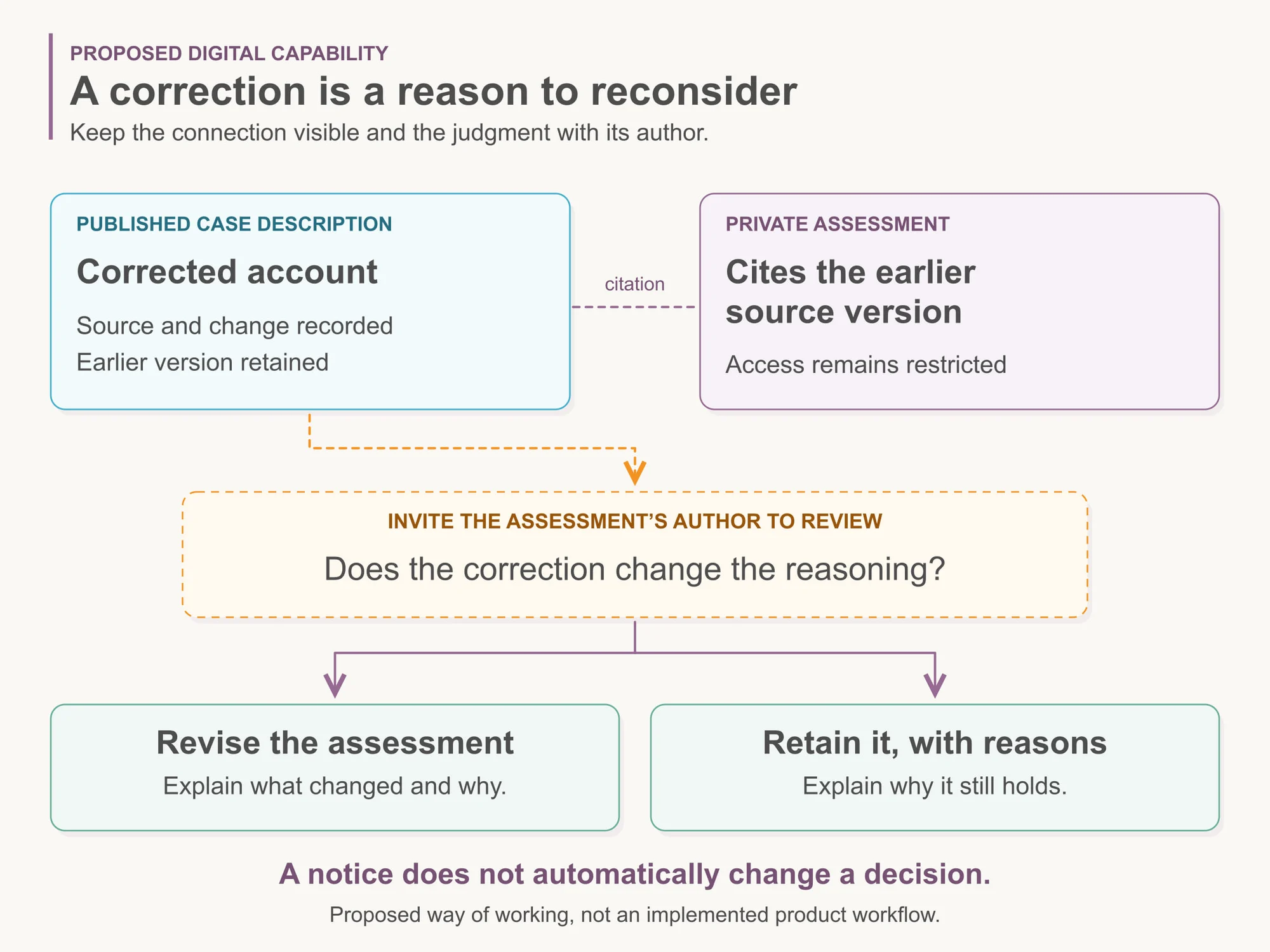
This would not require everyone to edit one universal record. A personal exploration, a private assessment and a published case description serve different purposes and may have different authors and access rules. Their connections should be explicit: what was shared, by whom, for what purpose and which source or version it refers to.
For example, a corrected case description could identify assessments that cite the earlier version and invite their authors to reconsider the relevant claim. It should not silently rewrite their reasoning or imply that a decision has automatically changed. The useful digital capability is helping people find the work that needs attention while retaining the history needed to understand it.
But the software would only be part of the arrangement. Someone must maintain the knowledge, respond to contributions and decide which changes warrant further review. Institutions would need to say how input can affect their work; a submission box alone gives no such assurance. Contributors should be able to see whether a concern was considered, what followed and, where it was not acted on, why.
Access also cannot depend on mastering the platform. Clear language, accessible interaction and supported or non-digital ways to contribute would be essential. A person should be able to speak with someone and check the resulting account without creating an online profile. Sharing should not expose personal circumstances more widely than the contributor intended.
The justification for a platform is therefore specific: it could make different kinds of work easier to connect, revisit and correct. Whether it actually does so would need to be tested with the people doing that work. More participation fields or a larger collection of records would not, by themselves, demonstrate success.
A better answer to a practical question
Let’s return to the person who wants rehabilitation to fit into their life, and the researcher deciding what to develop next. One needs to understand possibilities and express what would make them worthwhile. The other needs to see what a proposed improvement must address. Neither should have to adopt the other’s role to be useful to them.
If their work is connected well, the researcher can see why a schedule requires more than a technical improvement. The person considering it can see whether the response addresses their concern — and can challenge it if it does not. A wider enquiry can investigate whether that concern deserves attention elsewhere, without claiming more than its evidence supports.
For the person hoping to practise rehabilitation at home, the first useful result may not be a recommendation. It may be a clearer goal, alternatives worth discussing and questions they had not known to ask.
What would a tool designed for that kind of exploration look like? And how could it also help researchers or patient organisations investigate possibilities from their own starting points? That is where the next article begins.