

An early warning of fatigue could help a driver avoid an accident. A record of that warning could also influence how an employer judges the driver. The distinction depends on what people do with the information, not simply on how accurately a device detects fatigue.
This is a concrete question for neurotechnology. In a case study published in December 2024, the European Agency for Safety and Health at Work, EU-OSHA, describes an EEG headband used in mining and transport. Electroencephalography, or EEG, records electrical activity associated with the brain. In the described system, it supports estimates of fatigue, feedback to drivers and alerts to supervisors through an app and cloud-based analysis.
The case is based on desk research and interviews, rather than a controlled trial establishing the system’s safety benefit. It nevertheless makes an important arrangement visible: information derived from a person’s brain activity can become part of someone else’s decision about that person.
Brain–computer interfaces (BCIs) can help someone communicate or control a device, but they can also interpret brain activity without the person deliberately issuing a command. In workplace fatigue monitoring, that information can help a worker recognise a need to rest and help a supervisor organise a safer response. The important questions concern who receives the information, which decisions it can inform and how much say the worker has in those decisions.
For society to benefit from a new technology, it needs to learn what happens as that technology develops and enters everyday use. Promising results may not carry over to every setting, while useful applications may emerge that nobody initially anticipated. Monitoring provides that continuing attention: following developments, examining people’s experiences and revisiting earlier judgments as evidence accumulates. It helps public institutions recognise beneficial practices worth supporting, identify emerging problems and check whether safeguards work in practice. Without it, decisions risk remaining tied to the technology as it was first understood, rather than to what it has become.
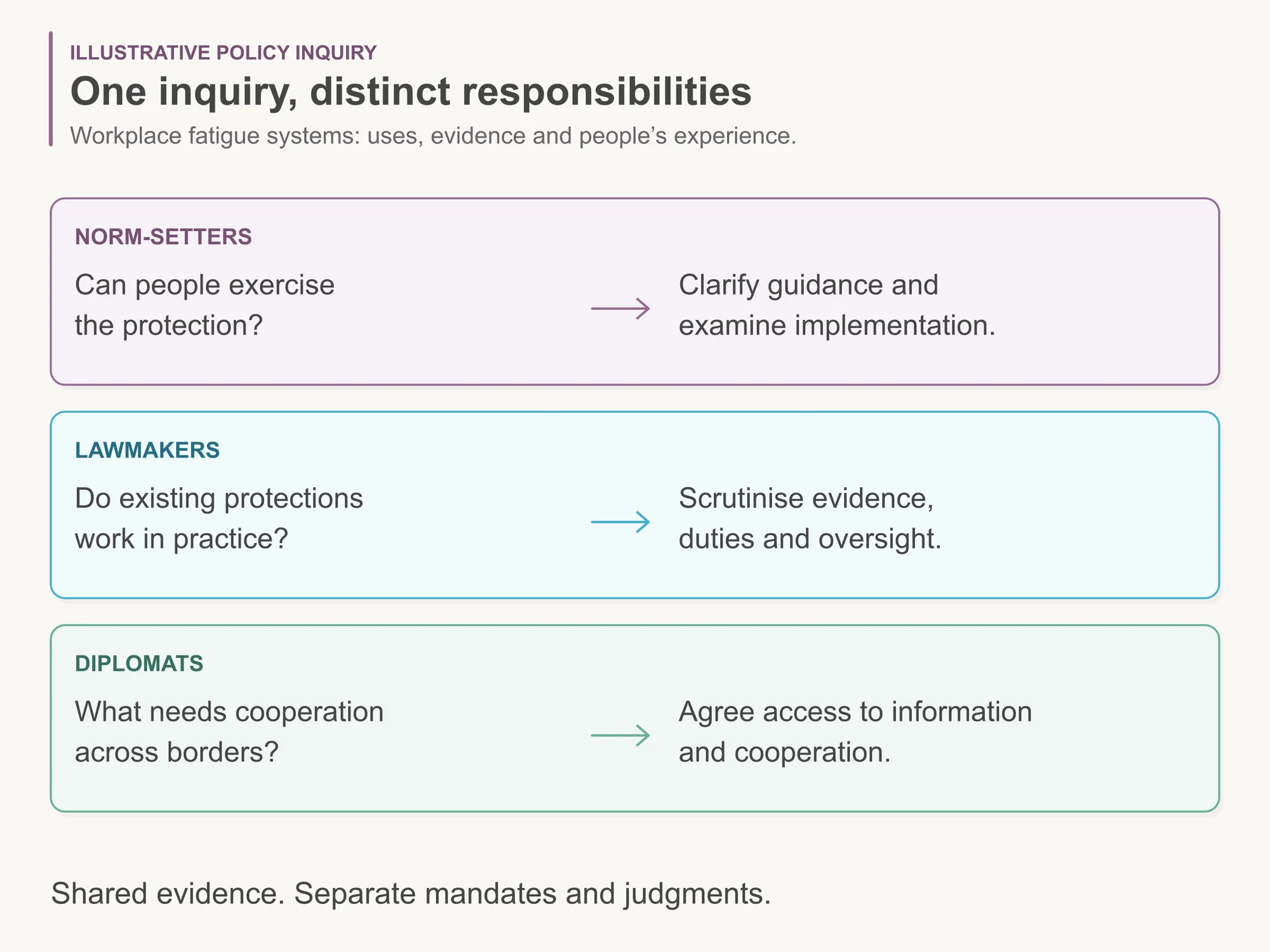
For a norm-setter, the question may be whether guidance makes acceptable use clear enough. A lawmaker may need to understand whether existing protections work in practice. A diplomat may need to establish what can be agreed when suppliers, services and users sit in different countries. Following technical progress helps all three. Following how that progress changes people’s circumstances gives them a basis for action.
Follow what happens after the warning
The intended benefit is worth taking seriously. If a warning helps someone stop before an accident, workers and others around them could gain from it. But recognising fatigue and being able to respond to it are different things. A worker may need permission to stop, somewhere safe to rest, and a working arrangement that does not make repeated exhaustion inevitable.
To work through a monitoring method, consider an illustrative policy inquiry into brain-based fatigue systems used at work. Its central question could be: Under what arrangements can these systems improve safety without making workers more vulnerable to decisions they cannot understand or challenge? (This is a proposed inquiry, not a finding about the employer or developer in the EU-OSHA case.)
That kind of question tells the policy team what information to seek. Evidence about detection accuracy belongs in the inquiry, alongside accounts of what happens after an alert. The team would look for the measures available to a worker, the decisions supervisors can make, the information retained and the people allowed to use it. It would ask workers and their representatives what those arrangements mean in practice.
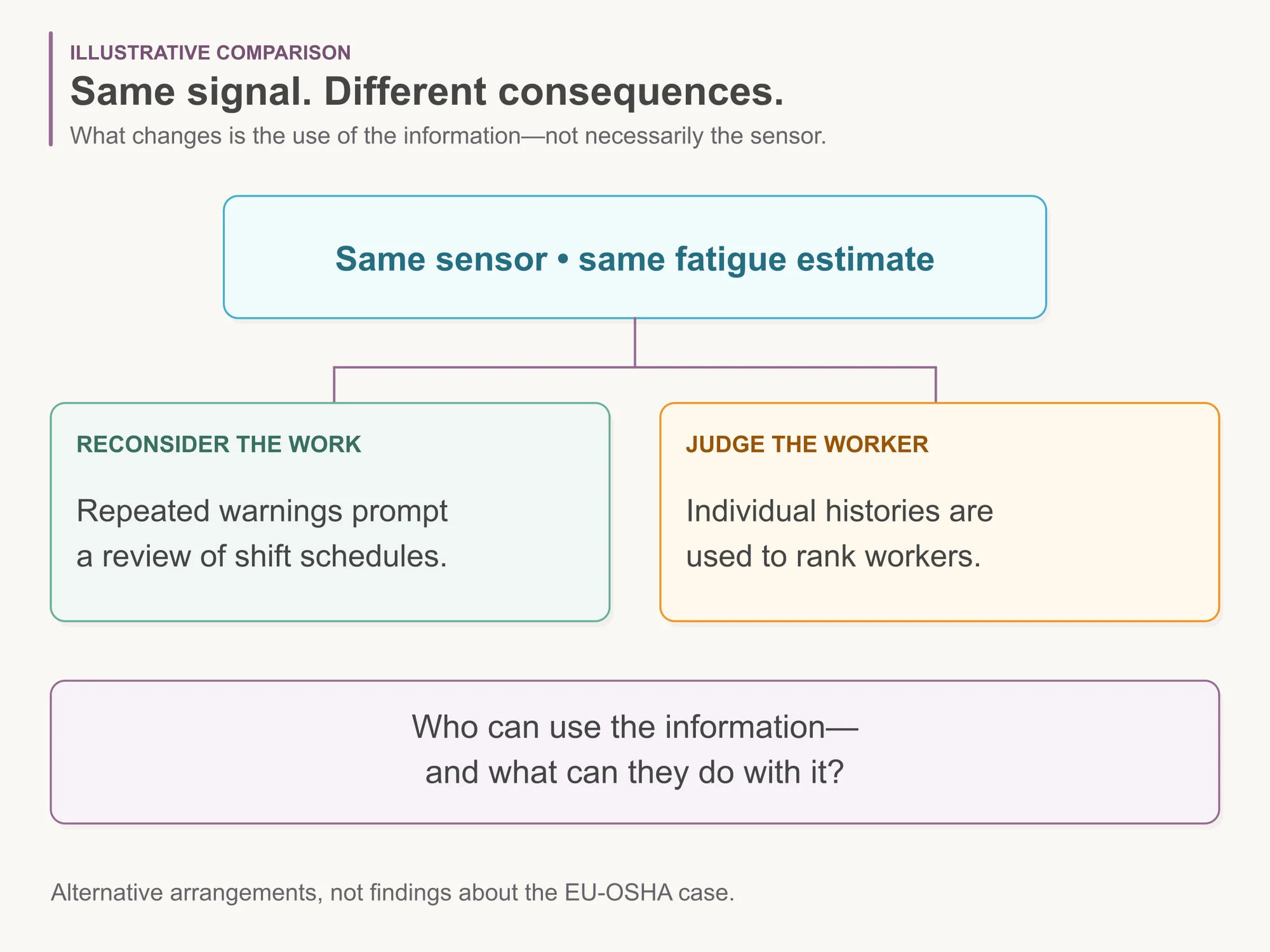
An illustrative comparison makes the stakes easier to see. In one arrangement, repeated warnings lead a workplace to reconsider shift schedules. In another, individual histories are used to rank workers. Both could involve the same sensor and the same estimate of fatigue. Yet the relationship between the technology, its intended benefit, and the people affected has changed.
This is why a list of new devices is an incomplete basis for public policy. A consequential development may be a new capability, but it may also be a new customer, contractual term, data recipient or use of an existing output. Monitoring needs to follow those changes before a familiar label such as workplace safety hides a different practice.
The OECD’s Neurotechnology Toolkit offers a useful starting point. It recommends combining horizon scanning, technology assessment, and scenario planning with interdisciplinary expertise and diverse participation. In practical terms, scanning helps identify developments; examining their operating arrangements clarifies what they could mean; scenarios test which plausible changes would make a different response necessary. A scenario is preparation for a possibility, not evidence that it has occurred.
Establish a baseline that can be revisited
Before a policy team can say that something has changed, it needs an account of what was previously known. For the fatigue inquiry, that account should identify the system, its intended use, the workplace setting, the people affected and the evidence supporting each description. The date and place of the reported activity matter, as do the version of the software and the employer’s policy where those are available.
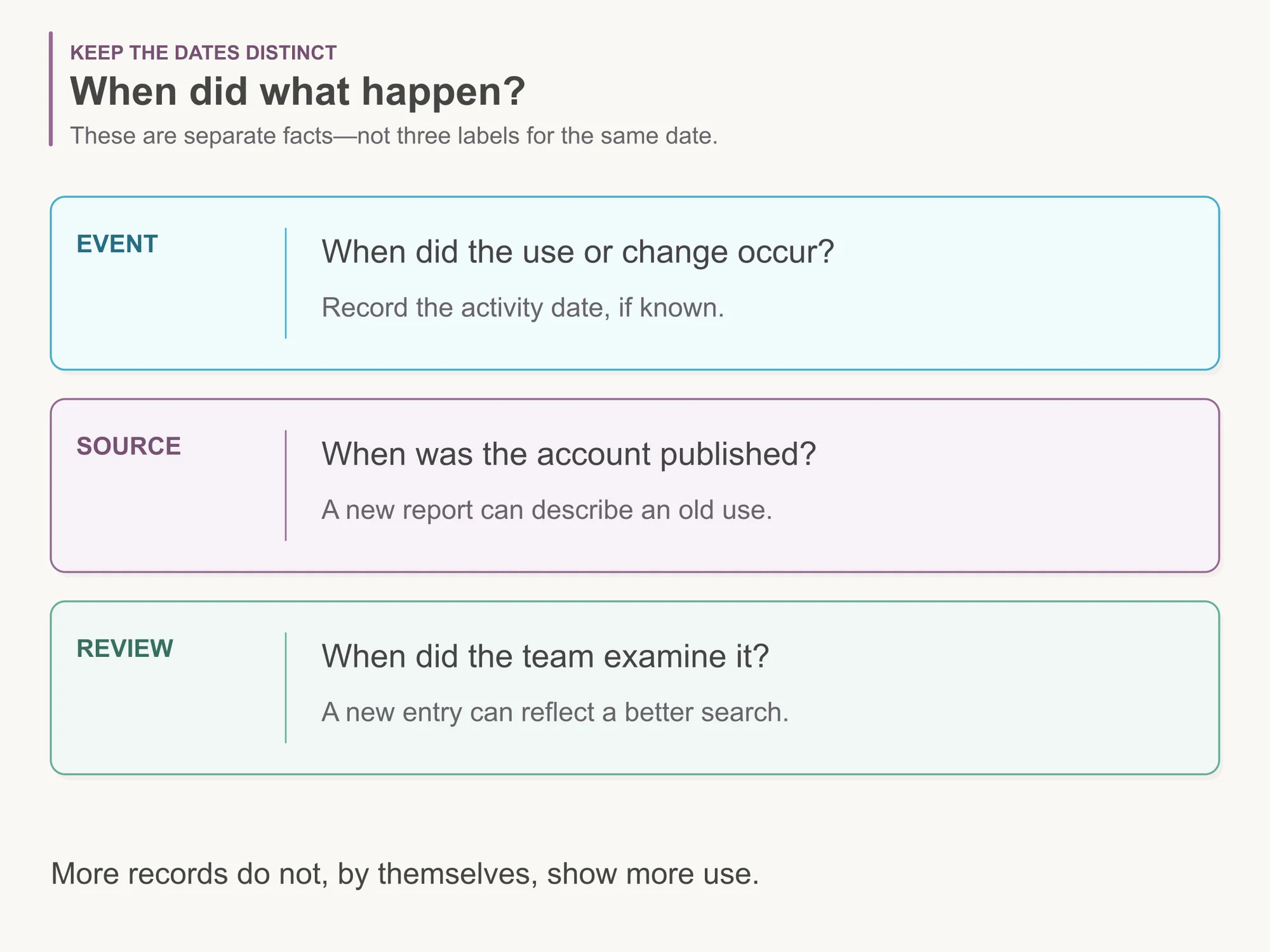
The source’s publication date is a separate piece of information. A recently published report can describe an older deployment. A new entry in a database can simply mean that somebody found it. Neither establishes that the technology has just entered a workplace. Keeping the event date, source date, and date of review separate prevents an improvement in documentation from looking like an acceleration in adoption.
The same care applies when moving from one case to a pattern. A policy team might define a manageable collection of documented workplace uses that estimate fatigue from neural signals. A laboratory study would remain distinguishable from an operational deployment. A product offered for sale would not count as evidence that workers are using it. Camera-based fatigue systems could provide a useful comparison, but should not quietly be counted as brain-sensing devices.
For each included arrangement, the team could seek the same core information: what is measured, what is inferred, who receives the output, what decisions follow and how affected people can question them. A recurring unanswered question may justify asking suppliers or employers to disclose more. It does not prove that the safeguard is absent.
If a later review finds more documented deployments, the team must also ask whether its search has improved. Perhaps it added another language, obtained access to a registry or received information from a workers’ organisation. To claim growth in use, it needs comparable observations and an account of what the collection covers. Counts of records are useful for managing an inquiry; they are not automatically statistics about the world.
The ideal scenario is that this discipline makes the inquiry more attentive, not slower to respond. A credible report of serious harm can deserve urgent investigation even when prevalence is unknown. Conversely, silence from a workplace may indicate that reporting is difficult. A monitoring method that hears only from organisations with polished public documentation will miss some of the people most in need of protection.
Norm-setters need to see where guidance becomes difficult to apply
Norm-setters develop shared expectations for responsible conduct. Their task is not finished when a principle has been agreed: they also need to learn where people struggle to put it into practice.
There is already a substantive reference for our workplace example. UNESCO’s Recommendation on the Ethics of Neurotechnology, adopted in November 2025, addresses voluntary workplace use, workers’ participation and protection against adverse consequences. Its labour provisions reject using neurotechnology for punitive measures or performance evaluation. These are policy expectations in an international recommendation, not a finding that a particular deployment violates domestic law.
A norm-setting body could use those provisions to sharpen its inquiry. If participation is described as voluntary, what happens when someone declines? If fatigue information is restricted to safety purposes, who checks how managers actually use it? The answers require more than a consent form or a supplier’s assurance. They require evidence about working arrangements and the experience of people subject to them.
Imagine that several independently documented cases reveal uncertainty about the difference between an immediate safety intervention and a later employment judgment. The useful output might be guidance that explains the distinction through worked examples, developed with workers, employers, occupational-health specialists and relevant authorities. That would give organisations a clearer basis for designing their procedures and workers a clearer account of what to expect.
Technical standards can contribute a different part of this work. ISO/IEC 8663:2025, for example, establishes vocabulary for brain–computer interfaces. Shared terminology helps people describe and compare systems. It does not settle whether an employer’s use is acceptable. A technical standard, an ethical recommendation and a legal requirement must remain distinguishable even when they address the same technology.
The monitoring question for a norm-setter therefore changes:
- from Have organisations endorsed the principle?
- to What evidence would show that people can exercise the protection it is meant to provide?
Recurring difficulties can inform clearer guidance. Evidence that an arrangement works can also help others implement it.
Lawmakers need to distinguish missing protection from missing evidence
A lawmaker has a different responsibility. Reports of a new workplace use may justify scrutiny, but they do not establish that a new law is the right response. The first task is to understand the practice and examine the protections already applicable to it.
For instance, where the EU General Data Protection Regulation applies, purpose limitation and data minimisation are already part of the legal framework. A neural sensor does not make these questions start from zero. Determining which rules govern a specific workplace arrangement still requires examination of its facts, the jurisdiction and the relevant employment and safety requirements.
For our illustrative inquiry, a legislative committee could ask the responsible authorities what they know about workplace uses, how they determine lawful processing and what routes workers have to challenge consequential decisions. It could seek evidence from worker representatives, employers and technical specialists about how those routes operate. A formal right to complain and a usable way to exercise it are different things to investigate.
The resulting diagnosis matters. If the law clearly addresses a practice but the responsible authority lacks information or resources, better reporting or enforcement capacity may be needed. If relevant duties are unclear, guidance or legal clarification may be appropriate. If a material harm falls outside existing protection, a legislative response may be warranted. Each conclusion needs its own evidence; an empty field in a monitoring record cannot supply it.
The committee would also need to consider what a proposed response makes possible. A narrowly drawn requirement could help employers adopt a useful safety measure with clearer responsibilities. An unnecessarily broad restriction could obstruct beneficial use without addressing the practice causing concern. Monitoring should help distinguish those choices, including the burdens placed on workers, employers and oversight bodies.
After a measure is introduced, the inquiry continues. The number of policies published is not evidence that workers can challenge an incorrect interpretation or take a needed break. Follow-up needs to examine the intended change in practice, while recognising that observed improvements or problems may have more than one cause. Passing a measure creates another question to monitor; it does not answer it.
Diplomats need to identify what cannot be resolved nationally
An international comparison is useful when it identifies a problem countries need to solve together. Ranking them by the number of neurotechnology companies or laws would tell a diplomat little about how the fatigue information in our example is handled.
Consider an explicitly hypothetical arrangement in which a supplier is based in one country, a service processes information in another and workers use the system in a third. The first task is to verify those relationships. A reference to cloud processing does not by itself prove that data cross a border, and a company’s headquarters do not establish where its service operates.
If the relationships are confirmed, they create specific questions for dialogue. Which organisations can provide evidence about the system? Which authorities can obtain information when a concern arises? What can be shared without disclosing individual workers’ records? A contact point, an agreed description of a deployment or a procedure for exchanging relevant incident information may be a more useful immediate result than another broad declaration.
The comparison must also preserve differences in the instruments themselves. A country with an ethical recommendation, another with a binding legal duty and another with an enforcement decision have not taken interchangeable steps. Their records should show what each instrument covers, its status and when it applies. Otherwise, a map of apparent agreement can conceal different practical protections.
Diplomats can use shared evidence to establish where cooperation would help: comparable reporting, access to technical expertise, support for oversight capacity, or a clearer division of responsibility between authorities. Countries with limited resources need a way to examine the implications for their workers and services, not merely receive conclusions framed elsewhere. The people affected should have ways to contribute through representatives and accessible consultation, without needing to attend an international meeting.
The aim is not to make every country reach the same judgment. It is to make the factual basis and the unresolved dependencies clear enough for cooperation to address them. A shared concern becomes more actionable when the parties can say what information or commitment they need from one another.
Decide what would warrant another look
Monitoring the landscape becomes useful when the people responsible for an issue can explain what would change their next action. Otherwise, a watchlist can keep growing while every decision remains as it was.
Return to the illustrative fatigue inquiry. An early account describes alerts used for immediate safety responses. A later, verified workplace policy permits individual fatigue histories to inform performance appraisals (this is an imagined change, not an allegation about the EU-OSHA case). It would matter even if the device and its accuracy were unchanged: information has acquired a new consequence for the worker.
A norm-setter drawing on the UNESCO recommendation already has a clear expectation against performance evaluation. Its next task would be to examine whether that expectation is being taken up and what prevents it from becoming effective practice. The relevant domestic authority would need to determine how existing law applies; lawmakers could scrutinise whether protection and oversight arrangements are adequate. Diplomats might need to involve counterparts if obtaining evidence or addressing the practice depends on organisations abroad. The same development informs different actions without collapsing them into a single verdict.
A useful monitoring brief could make this reasoning explicit. For this hypothetical change, it might say:
The revised policy permits fatigue histories to inform performance appraisals. This change warrants examining how the agreed protection against that use is being implemented, even without evidence of a new technical capability. The norm-setting group needs to understand uptake of its guidance; the competent domestic authority needs to examine applicable legal protections. The policy’s effective date, its use in actual decisions and affected workers’ experience are the next evidence to obtain. International coordination may be needed if that work depends on organisations abroad. Lawfulness and prevalence remain undetermined. The conclusion should be revisited when those findings arrive, with credible reports of harm referred promptly rather than held for the routine review.
The team maintaining the brief needs an agreed person or body to review incoming information, a next review date and a route for urgent concerns. Those arrangements should fit the issue and the institution’s mandate. Recording an organisation’s name cannot make it accept a responsibility it has not agreed to carry.
Not every new item deserves the same response. A product announcement may warrant checking whether a capability exists. A documented change in permitted use may warrant closer examination before consequences are observed. Credible evidence of harm may require prompt action by an authorised body. The level of confidence needed to open an inquiry is not necessarily the level needed to impose a binding obligation.
Evidence of effective safeguards should also change the picture. Imagine a follow-up that documents, through workplace records and confidential worker accounts, that people can challenge inaccurate alerts and take needed rest without penalty. That would not by itself establish a reduction in accidents. It would give norm-setters a practical implementation example to examine and lawmakers evidence about which existing arrangements deserve support. Monitoring can help people learn how to enable beneficial use, as well as recognise when to intervene.
Across these decisions, it helps to separate three kinds of change:
- something changed in practice
- new evidence revealed an existing practice or
- the interpretation changed because a rule or guidance was revised
All can matter. They tell different stories about the field and call for different follow-up.

Keep the changing picture connected
A thoughtful briefing, a spreadsheet, and regular conversations can begin this work. Existing professional networks may notice a consequential change before any database does. The difficulty is maintaining the relationships as the inquiry grows: between a particular deployment, its source evidence, affected people, applicable instruments and the reasons an institution decided to act or wait.
In our example, a change in an employer’s permitted use could reopen a question about guidance, a domestic legal inquiry and a cross-border information request. An updated recommendation could make previously recorded arrangements worth examining again. A correction to the underlying evidence could alter all three judgments. Storing the documents together leaves someone responsible for discovering each connection again.
For sustained monitoring across cases, institutions and time, a digital platform becomes necessary infrastructure. It needs to do more than collect documents or reproduce a reporting form on a screen. It must keep the relationships inspectable: what a source establishes, which version of a practice it describes, what remains uncertain and which judgments depend on it. A new item should bring the relevant questions back into view for human review, not automatically declare a breach or prescribe a policy.
Designed around its users, such a platform would offer different ways into the same maintained evidence. A norm-setter could examine where a principle raises recurring implementation questions. A lawmaker could follow changes relevant to domestic scrutiny and distinguish missing information from an established protection gap. A diplomat could compare the arrangements requiring cooperation, with the status and scope of each country’s instruments still visible. Each could take away a readable, dated brief and retain responsibility for their own conclusion.
This requires curation as much as software. Someone must check sources, reconcile duplicate accounts, correct dates, preserve disagreements and explain gaps in coverage. The platform should make those limits visible, including when information is stale. Automated collection can help find material; it cannot establish that the material is accurate, representative or sufficient for a decision.
People affected need a way to question the account without exposing themselves. A system for monitoring workplace neurotechnology should not become a central store of workers’ brain recordings. Much of the relevant work concerns purposes, arrangements, evidence and responsibilities. Sensitive reports need protected channels and appropriate access; public summaries should disclose only what is justified. Participation must also remain possible through representatives, supported conversations and documents people can read without using the platform.
The advantage is that a change can be understood in relation to the people it affects and the decisions it should reopen. A well-designed, curated digital platform makes that continuing attention possible across institutions. It helps them keep the conditions for beneficial use in view as the technology, its uses, and the rules around it evolve.