

Making rehabilitation equipment quicker to prepare sounds like a useful improvement. But if someone still needs another person’s hands to prepare it, a faster setup may leave the most important problem untouched: they cannot practise on a day when no helper can come.
Recognising that distinction could change what an engineer designs, what a scientist investigates, and what a funder chooses to support. If the resulting work reduces the need for assistance, it could also change which possibilities a person and their care team consider. The decisions become more useful to one another when the connection survives in both directions: people’s circumstances shape the work, and what the work discovers returns to the people it could help.
Consider brain-computer interfaces, or BCIs, which use brain signals to interact with a computer or other equipment. In a 2025 study of rehabilitation after stroke, signals associated with attempted movement helped trigger electrical stimulation of a weakened hand. Participants used the system at home with caregiver assistance and remote professional guidance. Having a caregiver willing to help was a condition of participation.
That gives a concrete arrangement to think with: equipment, a person practising, someone helping nearby and professionals supporting the sessions remotely. Moving rehabilitation home changes where these people work together; it does not make their contributions disappear.
Now imagine someone who wants more opportunities to practise using their hand, with fewer clinic journeys. They value contact with a therapist, but their relative cannot make additional visits to help with equipment. This household and the developments that follow are illustrative, not accounts of the study’s participants or subsequent results.
Following this one constraint will show why three kinds of work belong together:
- Explore what would be useful,
- Assess the work intended to make it possible, and
- Monitor what can be learned across cases and as circumstances change.
Keeping those activities connected is how we begin to build decision infrastructure around an emerging technology and around the people it is meant to benefit.
EXPLORE what would make a difference
The person’s first question might be whether a BCI could help them practise at home. A useful exploration begins by asking what home practice would make possible and what it would require. The starting point is a life to improve, with several possible ways of doing so.
In this example, fewer journeys and more opportunities to practise are desirable. Regular professional guidance is also desirable. Additional reliance on a relative’s physical help is not workable. These circumstances distinguish two meanings of independence that are easily confused: needing less hands-on assistance and having less contact with a professional. Only the first is the actual goal here.
That distinction changes how existing research should be read. Evidence from a supported home arrangement can help the person and their care team understand a possibility. It cannot establish that the same approach would work without the help on which it depended. A more useful question emerges: could preparation require less hands-on help while appropriate professional guidance remains available?
Exploration should keep alternatives open, including non-BCI ways of pursuing home practice. A device may be one part of a workable arrangement; a different service or a combination of existing tools may deserve consideration too. Clinical suitability, practical availability and what the person wants remain separate questions to resolve.
The immediate gain is a clearer account of what matters: worthwhile practice, preparation that fits the help available, and continued professional guidance. The relative’s limits become a condition to respect rather than an obligation quietly added to make the technology work.
That account also contains a potential research question. With properly organised participation, people facing this difficulty could help a development team decide whether its proposed improvement addresses the right problem. The connection begins when the experience of using a technology can change what others choose to build.

ASSESS whether the proposed work addresses that need
Imagine a team developing an easier-to-fit cap for home rehabilitation. Its initial target is shorter preparation time. The exploration above gives it a reason to distinguish speed from dependence on another person.
A cap that a helper can fit more quickly could make sessions less demanding for both people. But it would not resolve our household’s constraint. A cap that some users could fit themselves might open a different possibility, provided the remaining equipment and session could also be managed appropriately.
Assessing the proposed research now means examining whether its design can establish the improvement that matters. Setup time alone would not answer the question. The team would need to identify which tasks still require assistance, how often help is needed and whether preparation remains reliable and comfortable. People with relevant abilities and home circumstances should help define the target and the conditions under which it would be worthwhile.
A philanthropic foundation concerned with access might support that work, including accessible design, participant involvement and professional guidance during the study. A granting agency could examine whether the participants, methods and measures can answer the research question. Both can use the connection to an expressed need while applying their own responsibilities and funding criteria.
Some questions require evidence; others require a commitment. Whether the redesign reduces hands-on assistance is something a study can investigate. Who will provide professional guidance during that study requires an agreement, time and a budget. A proposal that describes support without securing it has not yet established the arrangement needed to do the research.
The same distinction matters when the findings reach publication. A paper reporting faster preparation should make clear who performed it and what help remained necessary. Editors and reviewers apply their journal’s standards, but the practical conditions of a result help future readers understand what it could mean for them. Preserving those conditions makes a finding usable beyond the team that produced it.
The original need has therefore changed the design target, the evidence to collect and the work worth considering for support. It has done so without making the person, scientist, funder and publisher responsible for the same decision. Nor does it require circulating a household’s private account: participation can help identify an issue for research, while the resulting question and evidence travel in an appropriately shareable form. One person’s situation opens an inquiry; it does not establish what everyone needs.
MONITOR what makes participation possible across cases
An individual study can reveal a promising arrangement. Looking across projects helps us understand how it compares with other approaches and whose circumstances remain unrepresented. An inquiry might find that some approaches rely on family assistance, others provide setup support through a service, and others describe their support requirements too poorly to tell. These possibilities lead to different questions and should remain distinguishable.
Monitoring, in this context, means following technologies, their uses and the conditions under which people may benefit. It includes looking for enabling practices worth learning from. If a service allows people to participate without relying on relatives, understanding how that service works could be as valuable as tracking improvements in the device.
A comparison betwen solutions can only answer questions its sources allow us to examine. Reviewing home-rehabilitation studies can show what assistance participants needed and whether people without an available helper were included. It cannot, by itself, tell us how many people could obtain that assistance outside the studies. If a paper does not describe the help provided, that remains an unanswered question , not evidence that participants managed alone. These precise distinctions need careful attention to be spotted, but are very valuable because they help public institutions identify what to investigate or improve. Suppose several studies required a relative to help with preparation. The technology might be promising, but an important question would remain: how could someone without that help benefit from it?
For norm-setters, this could justify clearer reporting requirements: studies should explain which tasks require assistance, who provides it and whose circumstances have not been tested. Readers could then distinguish a system that works at home with help from one that people can use independently.
For lawmakers, it could prompt a question to health authorities: if this approach enters routine care, what provision would allow people without an available family helper to use it?
For diplomats, the opportunity could be to bring countries together around the same practical question. Comparing how different programmes organise assistance could reveal arrangements worth adapting elsewhere. Comparable descriptions would make that exchange useful, while leaving each country to consider what fits its services and resources.
The findings can also change research and funding. If the reviewed evidence rarely includes people without an available helper, a foundation could consider work that includes them. If a promising support arrangement is documented but poorly understood, the next useful study might investigate how it operates rather than redesign the device again.
Here, the wider view changes the particular project. It helps identify a missing question, a group whose experience needs to be included or an enabling service worth examining. Monitoring supplies reasons to reconsider what to explore and what to assess; it is not simply an inspection at the end of development.

Let new knowledge reopen the original possibility
Now imagine that a later study provides credible evidence that some participants can prepare the redesigned system with less hands-on assistance while retaining remote professional guidance. This is a hypothetical future finding, not a result of the cited 2025 study.
For the person in our example, it could justify another conversation about an option previously questioned because of its assistance requirements. Their care team would still need to examine the study’s participants and conditions, alongside clinical suitability and practical availability. What has changed is specific: there may now be evidence relevant to the constraint that made the option difficult to pursue.
Researchers and funders could draw a different consequence from the same finding. The next priority might be reliability in varied homes, inclusion of people with different abilities or sustainable professional support. Another reduction in preparation time might contribute less than work that makes the demonstrated improvement usable in more circumstances.
Public institutions could investigate the new arrangement alongside other approaches. If later evidence also showed wider participation, they could examine which conditions enabled it and which might be supported elsewhere. Easier preparation and wider access remain different claims; the second needs evidence of its own.
What one group has learned can therefore change the questions available to others. The person is considering a possibility in their life. The funder is considering work to support. A public institution is examining conditions that may matter across many lives. Their decisions remain distinct, but each can become better informed through its connection to the others.
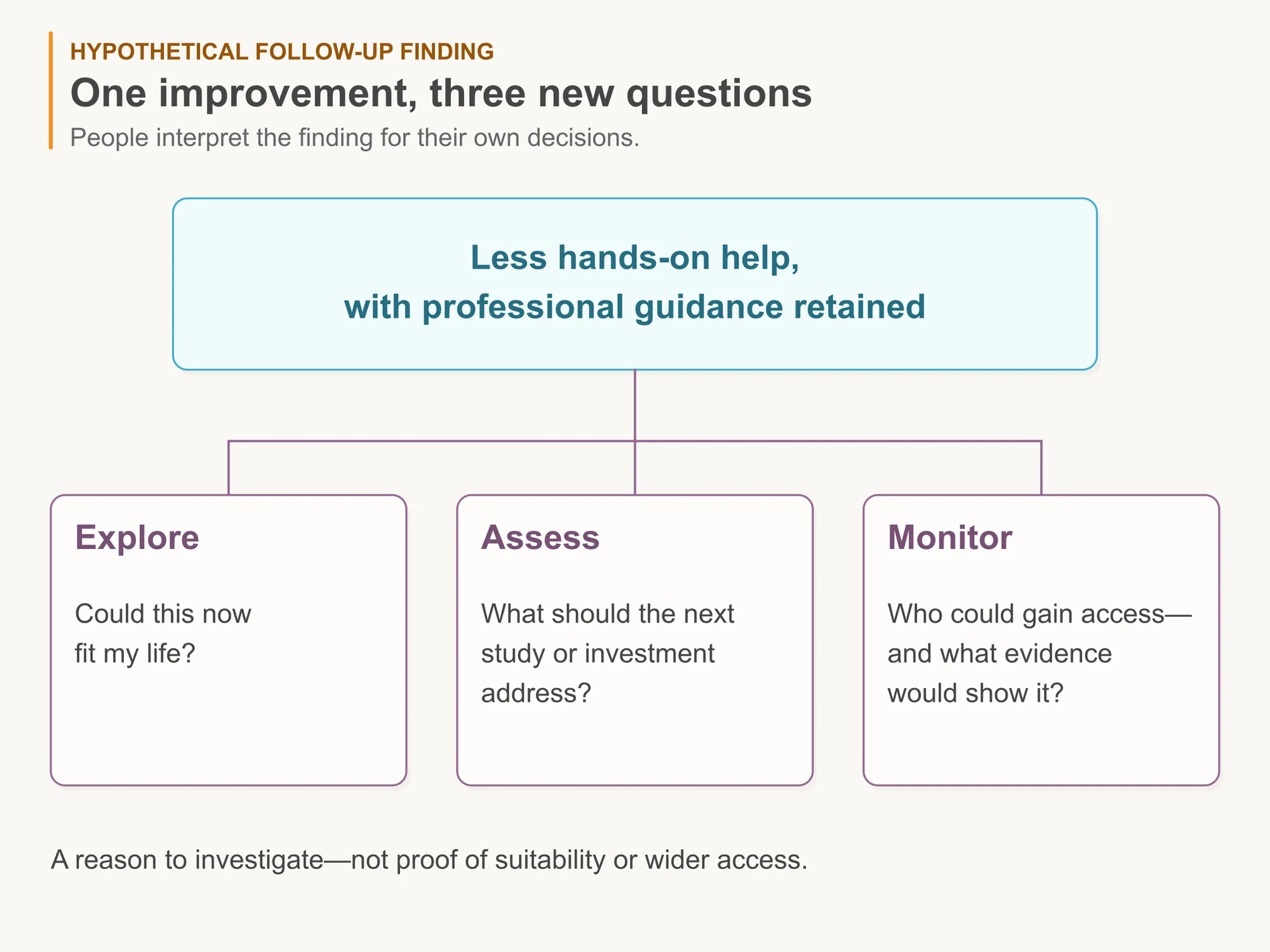
This return journey is what gives the connection its value. The person’s circumstances helped clarify an improvement worth investigating; the investigation can now change what is worth considering for that person. A research result has become relevant to a choice, and the reason for that relevance is still visible.
When connections become Decision Infrastructure
A thoughtful conversation can produce one such connection. A useful paper can produce another. To make them dependable across many people, projects and revisions, we need an arrangement that others can continue to use without reconstructing the reasoning from the beginning.
Decision infrastructure is the maintained combination of evidence, methods, digital tools, and responsibilities that enables different people’s decisions to inform one another over time.
In our example, the relevant parts are now visible. A need explains why a question matters. A source shows what has been established and under which conditions. An assessment relates that evidence to a particular choice. A wider inquiry reveals patterns and gaps. New knowledge provides a reason to revisit an earlier judgment, and an identified person or institution has responsibility for considering it.
EXPLORE, ASSESS, and MONITOR give this work three complementary purposes. Exploration keeps the intended benefit and alternative routes open to examination. Assessment tests what a particular project and its evidence justify. Monitoring brings knowledge from other cases and changing circumstances back into those inquiries. Their connection creates a capacity to learn across decisions, rather than merely accumulate the outputs of each activity.
There is no compulsory starting point. A patient organisation might begin with a recurring difficulty, a foundation with a pattern across its grants, or a scientist with a capability whose useful applications remain uncertain. Nor does one profession own one activity. A scientist may need to explore before designing a study and monitor findings while assessing its next phase.
The infrastructure is working when a consequential change can be related to the questions it affects and considered by the people responsible. For our example, a team could record the assistance requirement, the evidence behind its current view and what finding would warrant reconsideration. The researchers might revisit the requirement at their next design review; the person and their care team might examine available options at a planned discussion. Recording why the question remains open and agreeing who will look again gives each a usable starting point. Storing all the documents is only part of that work.

An established idea, with a public-interest challenge
Building arrangements around interdependent decisions has precedents in business and defence. In companies, sales and operations planning connects functions around an operating plan for allocating resources. In defence, NATO’s Federated Mission Networking combines people, processes and technology to support information-sharing and decision-making across participating organisations, with governance and an ongoing foundation of standards and capabilities.
Public-interest fields have related approaches too. Collaborative surveillance in public health, for example, provides a framework for connecting multiple sources and sectors to inform responses to health emergencies. The challenge for emerging technologies is to sustain such connections across the people and institutions whose decisions shape their use.
Neurotechnology shows why this matters. An OECD report on neurodata governance published in October 2026, drawing on a multi-stakeholder workshop and research with selected companies, describes fragmented coverage across medical-device rules, data protection, cybersecurity, consumer protection, AI oversight and research ethics. It also identifies uncertainty about responsibilities where several actors are involved.
The challenge is to bring existing expertise and obligations into relation. The relevant lesson from these precedents is the continuing investment in shared information and ways of working. In public-interest technology governance, those arrangements must accommodate different mandates, values and choices.
For emerging technologies in the public interest, there may be no single decision-maker and no agreed objective that resolves every choice. A person can decline an option a funder considers worth researching. A scientific result can be credible while its use raises unresolved public questions. Decision infrastructure should make the reasons and dependencies easier to examine without requiring agreement or giving one participant authority over the others.
That also makes it possible to act earlier and more precisely: identify an enabling arrangement worth studying, direct a grant towards an unresolved condition, or recognise that a new finding warrants another look. Speed comes from being able to build on intelligible work, with the relevant questions already connected to their evidence and responsibilities.

Maintain the meaning, not just the information
Those connections are only as useful as the accounts they carry. Calling the original intervention independent home use would erase the assistance that made it possible. Calling the hypothetical redesign less support could confuse reduced physical help with reduced professional guidance. Both descriptions would make the information easier to summarise and less useful for deciding.
For a consequential claim, the record therefore needs to preserve what was found, for whom, under which conditions and where that account comes from. It must distinguish a person’s requirement from a research finding, and both from a commitment someone has agreed to fulfil. A short explanation can remain readable while letting a specialist follow it back to the underlying source.
This requires curation: people checking sources, examining interpretations, preserving uncertainty and correcting accounts. Curation belongs inside the infrastructure because an altered interpretation can affect several decisions even when the technology itself has not changed.
If a source is corrected, the earlier account and the nature of the correction should remain identifiable. The people responsible for a judgment can then examine whether its basis has changed. Where others relied on that judgment, those responsible need to consider how to communicate the revision through the appropriate clinical, research or institutional channels. Updating a database does not, by itself, complete that responsibility.
People also need a way to challenge how their contributions are represented. A relative’s inability to make more visits should not become a general objection to technology. A person’s willingness to discuss an experience should not make their private circumstances available to everyone. Shared references, private working records and permission to disclose information have different purposes.
Maintaining those distinctions allows useful knowledge to travel without requiring every participant to share the same record or conclusion. It also keeps gaps in responsibility visible. If professional support is essential but no provider has committed to it, the infrastructure should expose that unresolved condition rather than let a completed form make the arrangement appear ready.
Give different people usable ways into the whole picture
Much of this work can begin with paper, a careful conversation, and a few sources. A good facilitator may notice an ambiguity that a form misses. A decision letter or research paper can preserve a conclusion in a durable, readable form.
The requirements change when the connections must remain usable across many people and over time. A study is revised, someone clarifies the help they can offer, or a new approach addresses a previously unresolved constraint. Each change may matter to several inquiries, for different reasons. Repeatedly rebuilding those relationships from separate documents makes continued learning depend on whoever happens to remember them.
For this to become a continuing, inspectable practice across an ecosystem, a connected digital platform — or interoperable platforms — is necessary. Its job is to maintain relationships between needs, evidence, conditions and judgments, with sources, versions and access boundaries that people can inspect. Digitising a form or assembling files in a shared folder does not provide those relationships by itself.
Consider how the same source-backed account of assistance requirements should serve different users. A person exploring home practice needs a clear explanation of what help an approach involves and what remains unknown. A scientist needs the detailed evidence and its implications for a study design. A funder needs to examine what proposed work could resolve and which commitments it depends on. Someone monitoring a selected set of cases needs comparable descriptions, with differences and gaps still visible.
A well-designed digital platform lets each begin with a relevant view while retaining access to the wider reasoning. It should be possible to move from a concise explanation to the evidence behind it, distinguish an unresolved question from a demonstrated limitation, and see when an account has changed. Simplifying the interface should not remove the conditions that make the answer meaningful.
This is why user-centered design is part of the infrastructure, rather than a final improvement to its appearance. Someone with limited energy, communication difficulties or no interest in mastering a specialist framework should not have to navigate the whole research and policy system to explain what matters to them. Supported conversations, accessible explanations and the ability to contribute through a professional or representative can make participation possible without requiring everyone to operate the software directly.
The benefit extends beyond administrative efficiency. A practical difficulty can remain intelligible when research targets are chosen. A well-documented success can suggest opportunities elsewhere. A new finding can give people grounds to reopen a possibility previously set aside. The digital infrastructure must maintain the connections that make these contributions usable; people and institutions supply the interpretation, resources and follow-through that make them consequential.
Putting the approach into practice with the GESDA Compass
This is the approach behind the GESDA Compass, a user-centered digital platform that brings EXPLORE, ASSESS, and MONITOR together as different ways of working with related knowledge.
EXPLORE helps people articulate goals, consider alternatives and record requirements and unanswered questions. Published cases offer references to investigate, and an exploration can produce a brief for a conversation. ASSESS supports examination of a particular project’s purpose, evidence and uncertainties, with questions and briefs relevant to different responsibilities. MONITOR supports inquiry across selected public catalogue records or a separately authorised portfolio of assessments.
The practical connection is a curated knowledge base. A published case can inform exploration, be opened explicitly as the starting point for an editable assessment, or be considered alongside other cases. CARTOGRAPHER, the catalogue-maintenance application, supports human review, correction and controlled publication of those source-linked accounts.
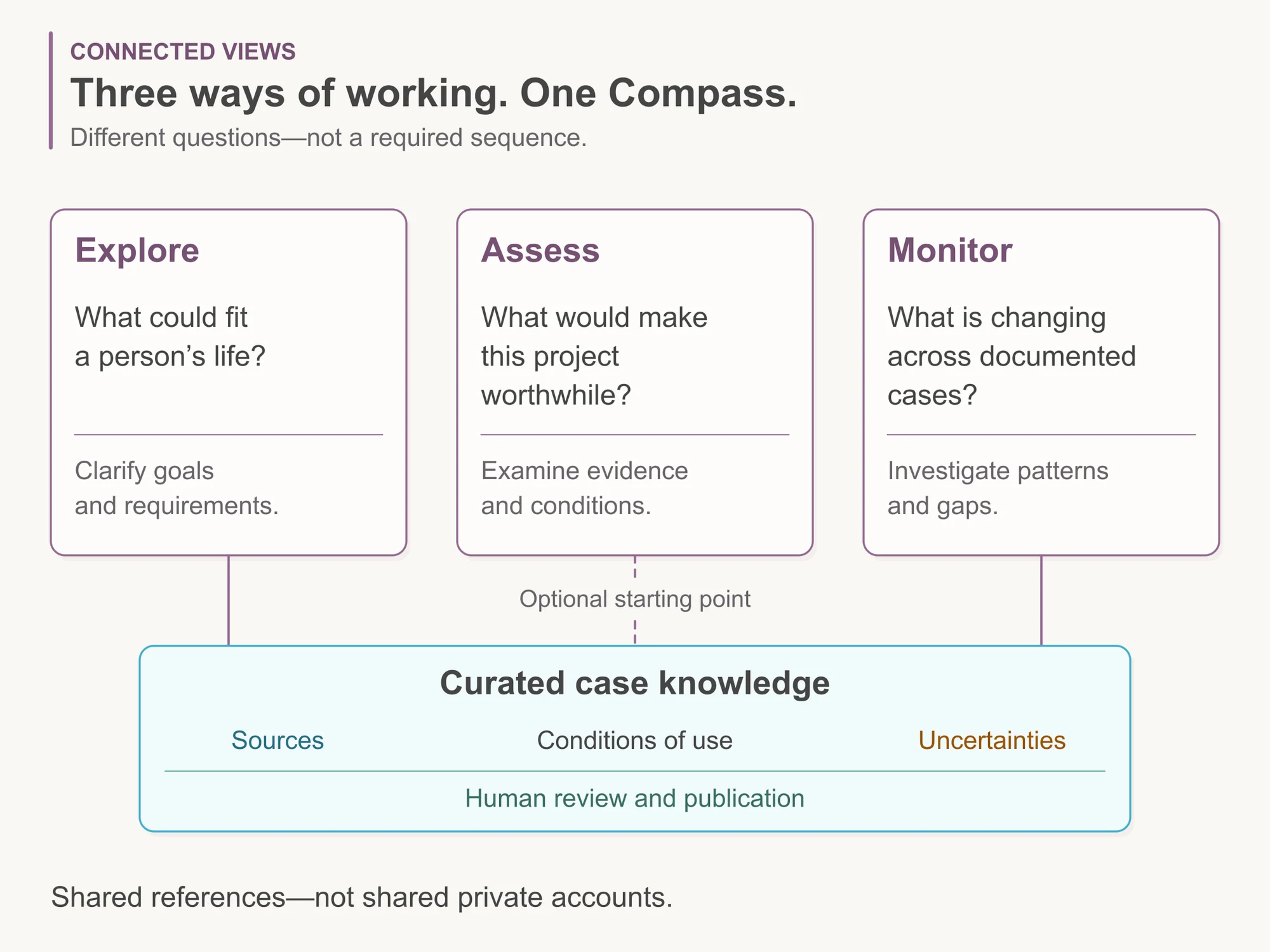
These are concrete parts of decision infrastructure, not an automated patient-to-research-to-policy process. Personal explorations and private assessments are not automatically published. Starting an assessment from a catalogue case does not keep it automatically synchronised with later catalogue changes. People still decide what to share, commission the work, secure commitments and consider what changed evidence means for their judgments.
The wider ambition is to make that connected practice easier to sustain. EXPLORE keeps attention on what should become possible; ASSESS examines the work and evidence that could make it possible; MONITOR brings experience and changing knowledge back into view. Together, supported by curation, they provide a practical basis for decisions to inform one another without becoming the same decision.
For the person at home, the aim remains worthwhile practice that fits into their life, with help they can count on. Their circumstances can shape the research question, guide the investment and remain visible when wider lessons are drawn. When what those activities discover can return as better possibilities for that person, scientific progress gains a clearer direction: towards improvements people can actually use.