
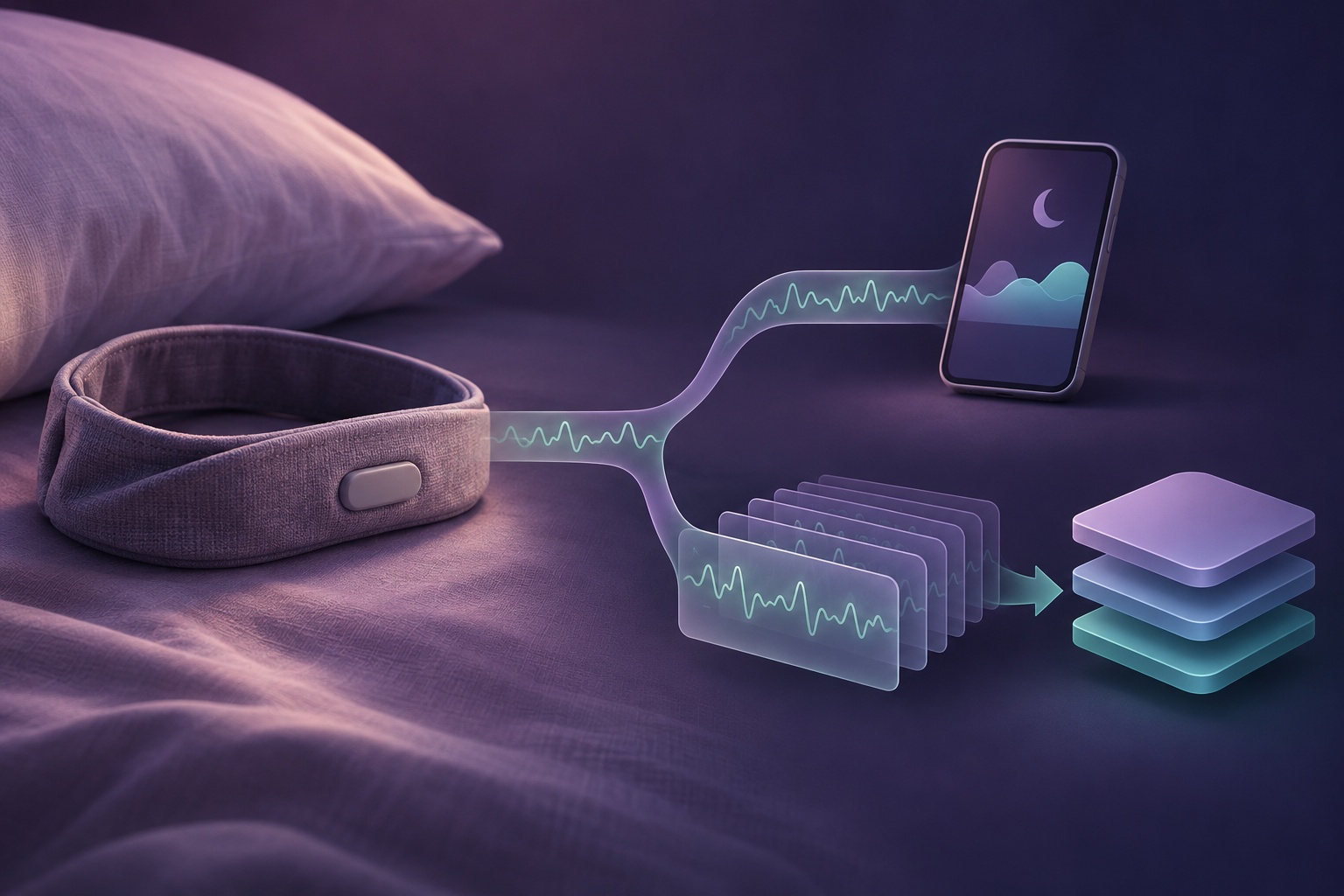
A person buys a headband to understand their sleep. During the night, it records signals. In the morning, an application turns those signals into feedback. The exchange seems reasonably clear: information about the wearer supports a service for the wearer.
Those recordings may also become material for training a model that serves other purposes. The person is now contributing to something whose future users, applications and consequences may extend well beyond their sleep report.
That second use is the subject of Jonathan Moens's November 2026 investigation in Science. It reports that companies have used consumer brain recordings to develop AI models without clearly informing users. A reader might reasonably wonder: what can these devices actually learn about me? How much should I worry about my recordings being used this way?
We can bring those questions to the GESDA Compass, a platform that helps people explore emerging technologies, assess evidence and consider possible futures. By looking at the research and the guidance available, we can separate what is known today from risks that may emerge as the technology develops, and see where the evidence is still too limited to draw a conclusion.
Start with the permission, then examine the capability
One example is Muse, a headband made by the Canadian company Interaxon and used for sleep and meditation feedback. Its privacy policy, dated 29 September 2026, says de-identified or aggregated information is used to train algorithms and machine-learning models, including foundation models. Another company, EMOTIV, makes EEG headsets and in its privacy policy describes training and commercializing its Large Brain Model with pseudonymized neural data and telemetry, subject to explicit opt-in consent.
These statements establish what the companies now disclose. They do not independently establish which recordings entered a particular model, what each user saw beforehand, or how the consent controls operated. A present-day policy cannot settle the history of an earlier training run. That requires dated notices, records of user choices and a documented connection between those choices and the training data.
The phrase “harvesting brain data” in the Science headline covers several distinct steps. A device may record signals. A company may retain them. A training process may use them. A later model may infer something from new recordings. Each step needs its own evidence.
Electroencephalography, or EEG, measures electrical activity through electrodes on the scalp. A recording is a signal that must be interpreted in relation to the sensors, recording conditions and task. Calling a model a brain foundation model describes an ambition to learn patterns that can be adapted across tasks; it does not establish a comprehensive simulation of a person's mind. The open REVE research project, for example, reports results on specified EEG tasks including sleep staging and seizure detection. Its research results provide a reason to investigate useful applications, with validation still needed for each destination.
Language decoding makes the limits particularly visible. A 2025 study by d’Ascoli and colleagues examined recordings from people reading or listening to words, using EEG and magnetoencephalography, which measures magnetic signals. Performance depended on the equipment and experimental protocol; MEG and reading were easier to decode than EEG and listening. The study does not establish that an everyday consumer headband can recover a person's unrestricted private thoughts.
The evidence points to capabilities that depend on the task and recording conditions. Some systems can detect patterns associated with sleep or help identify words in an experiment; that does not mean a consumer headband can reliably interpret whatever a person is thinking. Claims about attention, emotion or health need the same scrutiny: what was measured, under which conditions, and how well did the result hold up for different people?
Limited signals can still have consequential uses
There is a genuine privacy question even when decoding remains narrow. In a controlled experiment published in 2012, Martinovic and colleagues asked participants to memorise a new four-digit PIN created for the experiment. The researchers then showed them digits on a screen, one at a time, while recording their brain activity with a consumer headset. Participants knew they would later be asked to enter the first digit. The researchers used the recordings to make a better-than-random guess at that digit; they did not recover the full PIN.
The distinction is important. The researchers had access to the recordings, controlled what appeared on the screen and knew the question they were trying to answer. They were testing whether a response to one of ten displayed digits could reveal something about a number the participant had been asked to remember. The experiment does not show that a headset can listen in on someone's thoughts during ordinary use, or that companies are conducting this kind of test on their customers. It does show why even a limited signal deserves a careful privacy assessment: under particular conditions, it can help someone make an informed guess about information the wearer has not shared.
The potential consequences also depend on who receives an inference. Consider an illustrative change in use: On one side, a person looks at a tentative attention score to decide whether to take a break; on the other, an employer receives the same score and uses it to allocate work. The second arrangement introduces authority, pressure and a need to challenge the result. Even an inaccurate score can affect someone if another person treats it as reliable evidence.
That workplace example is a scenario to examine, not a finding about Muse or EMOTIV, and it helps expose two separate tests. Is the inference valid enough for the proposed decision? Is that decision an acceptable use of the information? Better predictive performance cannot answer the second question by itself.
Removing names addresses another part of the problem. It can reduce direct identification, but it does not by itself demonstrate that a dataset cannot be linked back to individuals. Nor should a trained model automatically be assumed anonymous. In its opinion on AI models, the European Data Protection Board calls for a case-specific assessment of whether personal data can be extracted or obtained through model queries. That is a requirement for evidence, not a finding that these particular models expose their contributors.
Withdrawal needs similar precision. Stopping future collection, deleting an account, removing source recordings and addressing the influence of those recordings on an already trained model are different operations. A useful explanation would say which can be performed, how downstream copies are handled and what limitations remain. Promising that everything disappears when an account closes would require technical evidence; claiming that removal is universally impossible would also go beyond what has been established here.
International guidance already reaches this question
UNESCO's Recommendation on the Ethics of Neurotechnology was adopted on 11 November 2025. Paragraphs 49–50 address informed consent and safeguards such as purpose limitation; paragraph 92 explicitly addresses neural data in AI training and application. Its scope also reaches other data used to infer mental states. This is an adopted, non-binding recommendation to states, whose implementation depends on national measures.
The OECD's 2019 recommendation already called for protection of personal brain data, meaningful choices about its use and safeguards against discriminatory applications. Its October 2026 neurodata-governance report adds practical attention to classification, inferred data and coordination across regulatory regimes. These are international policy instruments and analysis, rather than a universal licensing system for headsets.
The European Group on Ethics takes the argument further in its September 2026 statement. It recommends examining the connected system of data collection, model development and downstream applications, including effects on people who never contributed training data. Its proposals include auditable provenance and safeguards for consequential uses. This is advice to the European Commission, not enacted legislation.
Existing law remains relevant. Where the EU General Data Protection Regulation applies, identifiable recordings engage requirements concerning lawful processing, transparency and purpose. Health data and biometric data used for unique identification can engage Article 9's additional conditions; the label “neural” alone does not settle the classification. Article 13(3) requires information before further processing for a different purpose. Consent is not the only possible legal basis, and genuinely anonymous information has a different status.
The EU AI Act supplies another boundary. Article 5(1)(f) prohibits specified emotion-inference uses in workplaces and educational institutions, with medical or safety exceptions. It is not a general ban on EEG or model training. Physical-state inference such as fatigue is distinguished from emotion recognition in the European Commission's guidance, so classification requires care.
The practical task is to identify the applicable provision, jurisdiction, actor and processing step. Calling a product “wellness” does not answer those questions. Neither does citing an international recommendation establish that a company has complied with it.
Who can help assess whether action is needed?
The Science investigation raises questions across a sector. An assessment could begin with an authority reviewing how existing rules apply, a consumer organisation checking what users are told, or a researcher testing a disputed claim. Each can contribute something the others cannot establish alone.
The Compass can help organise that inquiry by keeping evidence, unanswered questions and possible future uses distinguishable. The evidence may support leaving current arrangements in place, seeking more information or making a specific change. The table shows what each actor can contribute to that assessment; it describes possible contributions, rather than actions these organisations have already taken in response to this story.
| Who can contribute | Contribution to the assessment | Question to resolve |
|---|---|---|
| Data-protection or consumer-protection authority | Review the evidence and applicable rules to assess whether any further action is warranted. | What, if anything, needs clarification, closer examination or a regulatory response? |
| Consumer organisation or public-interest representative | Document users' experiences and assess whether explanations and controls support informed choices. | Do people understand the intended uses, and can they exercise the choices offered? |
| Scientist or research funder | Test claims about benefits, capabilities and privacy risks, or fund independent evaluation. | Which claims are supported, under what conditions, and which uncertainties need testing? |
| Manufacturer or model developer | Explain and test current data practices, safeguards and user controls. | Do current arrangements support the intended benefits and protect users, or is there a reason to change them? |
| Investor, research partner or institutional buyer | Assess evidence of benefits, data permissions and safeguards before making commitments. | Does the evidence support proceeding, setting conditions or seeking further assurance? |
| Policymaker or international norm setter | Assess how existing protections apply and whether any gaps require a response. | Are existing rules sufficient, or does the evidence justify clarification, coordination or change? |
Regulators: assess whether a response is warranted
An authority needs to establish whether the reporting points to a wider issue or to questions about particular practices. In the Compass's MONITOR view, an authority can examine the relevant records, compare their purposes and data arrangements, and follow privacy and governance questions back to individual cases. This helps distinguish concerns that recur in the available evidence from those that depend on a specific use.
When a specific practice merits closer examination, the authority can use ASSESS to record the service's purpose, current data use, supporting sources and unanswered questions. Limited thought-decoding ability would narrow one concern; whether users were adequately informed needs separate evidence. Dated notices, records of user choices and information about the training data can help resolve that question. Reviewers can record their explanation and references while leaving unsupported details unknown. A missing public document alone does not establish a violation.
Authorities have powers to pursue concerns where warranted. As the European Data Protection Board explains, national data-protection authorities can investigate and take corrective action. Consumer-protection authorities have a related interest in what people are promised: the US Federal Trade Commission's guidance for health apps addresses misleading disclosures and unsupported health-benefit claims. Which authority can act depends on the jurisdiction and conduct. The useful outcome is a reasoned decision about whether clarification, further investigation or no additional action is justified by the evidence available.
Consumer organisations: explain what the evidence means for users
A consumer organisation responding to the article first needs to decide what to tell people: what the evidence supports, what remains uncertain and what users need to ask. In the Compass's EXPLORE section, it can inspect published cases and their sources, examine potential consequences through the Impact map and explore relevant responsibilities. That provides a way to distinguish a claim about what a headband can infer from a question about how its recordings are reused. The conditions attached to a possible harm help explain what would have to happen for it to arise.
For a particular service or reuse arrangement, the organisation can use ASSESS to organise the available evidence and identify questions needing clarification. It can then examine the actual sign-up and withdrawal process with users and seek explanations from the company. Does declining model training affect the sleep service? Does closing an account stop future training, delete recordings, or do something more limited? Those checks help establish whether the choices work as described; the Compass provides a place to structure the inquiry and record the review.
Some users may welcome contributing to research; others may want only the feedback service. Their experiences help the organisation judge whether explanations and choices serve both groups. The result can be a clearer public explanation, a focused question to a company or, where the findings warrant it, a concern raised with an authority.
Researchers and funders: identify the evidence worth producing
A researcher's task is to turn a disputed claim into an answerable question. EXPLORE supports examining relevant published cases and following their sources to understand the conditions behind a result. Can a model infer sensitive information from recordings made by a consumer headband during ordinary use, or does it need selected images, repeated trials and additional information about the wearer? An experiment would need to specify what an outside party can access and compare its results with guesses made without the brain recordings.
For a proposed study, researchers can use ASSESS to describe the data source, study population, method and intended output. A study using existing recordings raises questions about permitted reuse and access; new data collection raises questions about what participants are being asked to contribute. The Compass helps organise those considerations alongside the evidence needed for the study's claims.
A research funder has a different initial decision: which unanswered question deserves support? In MONITOR, it can examine relevant research records and their evidence gaps to inform a research call. Priorities might include independent privacy tests, replication under everyday conditions or evidence that additional recordings improve an outcome users value. When proposals arrive, ASSESS supports reviewing each study and its safeguards. The funder can ask whether the proposed work will resolve the uncertainty that motivated the call, including results that could reduce concern or substantiate a benefit.
Manufacturers: assess data practices and safeguards
A manufacturer responding to the reporting needs to establish what its own evidence supports: what the product does, how recordings contribute to model development and whether its explanations accurately describe those practices. In ASSESS, the team can record the current purpose and reuse arrangements, examine the resulting review questions and document its answers with supporting references. Where training relies on consent, the underlying checks include whether training eligibility follows users' choices and whether the account of withdrawal matches what happens to recordings and models.
The team can also examine a proposed extension, such as using sleep recordings to train a model for another application. The Compass keeps the extension's assumptions separate from the current service and prompts review of the new purpose, affected people, benefits and permitted uses. This helps the company establish whether the proposal calls for additional evidence or safeguards. Shorter retention, fewer collected signals or more local processing are alternatives to consider where they can serve the intended purpose.
If relevant facts or scenario assumptions are later changed in the assessment, the Compass marks affected reviews for reassessment. The team can see which earlier explanations need another look. The review may support continuing under existing arrangements or identify a specific improvement; these are available checks, not findings that either named company lacks them.
Investors, partners and buyers: assess the basis for a commitment
Here the question concerns a particular commitment. An investor needs to understand the evidence behind a model's claims and its access to usable training data. A research partner needs to establish which uses of shared recordings are permitted and how access and withdrawal will be handled. A buyer needs evidence that the proposed service works for its intended use. The same headline can prompt each organisation to revisit a different part of its decision.
In ASSESS, each can examine the specific study, service or proposed reuse it is considering. The available evidence, unresolved conditions and review explanations provide a basis for due diligence. For example, a proposed data partnership can be examined for its stated purpose and permitted reuse without assuming that permission for the original sleep service covers the partner's work. Reviewers can record what supports their conclusion and what still needs clarification.
When the question concerns several projects, MONITOR lets the organisation examine its selected, accessible assessments together and identify cases needing a closer look. Decisions still concern the particular commitment: proceed on the evidence available, seek further assurances, agree a narrower use or decline. A funding or purchasing condition is one possible outcome of that inquiry.
Policymakers and norm setters: assess whether existing protections are sufficient
A policy team needs to establish whether the reporting points to a problem with existing protections, their application or the evidence available. MONITOR brings the relevant records into view. Its Frameworks in practice view links selected cases to safeguards and source provisions, while distinguishing recorded information from inferred or unresolved information. This helps the team identify what to examine more closely. Missing information about a case does not, by itself, demonstrate a gap in the rules.
The team can then use ASSESS to work through a defined current practice or an explicitly hypothetical future use. For example, moving recordings from personal sleep feedback into training for other applications changes the purposes and people to consider. The team can examine those changes alongside the relevant provisions and prepare a brief explaining whether existing protections remain sufficient. Evidence may support retaining current rules, clarifying their application, improving enforcement or considering a new safeguard.
An international norm setter has a related but distinct task: establish whether shared guidance or coordination would help, and on which questions. It can use MONITOR's framework connections and relevant records to prepare questions for discussion across jurisdictions. These might concern how to describe permitted reuse, what evidence supports a privacy claim or how to document a change in purpose. The useful output is a focused agenda grounded in cases and sources. A recurring evidence gap may call for better documentation or research; a demonstrated protection gap may warrant work on common guidance. The records inform that distinction, while the participating institutions make the policy judgment.
Together, these contributions could change both the account of the risk and the response to it. A scientific result might narrow a capability claim. Users' experiences might identify a consent problem. Company records might resolve that problem or give an authority grounds to act. The Compass can help keep those distinctions visible as evidence changes; gathering the evidence and exercising authority remain the work of the people and institutions concerned.
What response does the evidence justify?
For the person who bought a headband to understand their sleep, these inquiries return to the original concern: how worried should they be about their recordings becoming AI training data? The answer needs both scientific evidence about what the technology can reveal and evidence about how those recordings are actually used.
The sources reviewed here support scrutiny of data reuse, but do not establish that consumer headbands can recover unrestricted private thoughts or that every training use is harmful. The next useful step depends on the evidence: an exaggerated claim may need correction, an unclear practice may need clarification, and a plausible future harm may warrant a test or safeguard. The assessment may also find no grounds for additional action. The likelihood and severity of harm cannot be estimated for a particular service without knowing more about its recordings, models and how those models will be used.
The promising possibility is that people can contribute to useful research while retaining an understandable relationship to what they are helping build. That requires a specific account of the benefit, evidence that the proposed data use is needed, and limits that remain meaningful when a model reaches another setting.
The sleep headband may remain physically identical throughout. What changes is the purpose of its recordings, who can act on them and whose life those actions affect. Following those changes is how a privacy headline becomes a decision that can be explained, challenged and revised.
Sources checked on 11 November 2026. Company policies are statements of practice, not independent audits. The proposed responses and workplace example are illustrative. No company-specific Compass assessment, regulatory investigation or user consultation is represented here.