

A brain–computer interface could help someone communicate again while leaving them dependent on a research team to keep it working. Its performance might be accurately measured and honestly reported, yet important questions would remain: how much control does the person have over its output, who can access their neural data, and what happens when the funded study ends? Assessing the research means examining the conditions under which a scientific achievement could become a benefit someone can rely on.
Consider a striking result reported in 2024. Researchers used an implanted BCI, to translate the brain activity associated with attempted speech into text and spoken output for a man with amyotrophic lateral sclerosis, or ALS. On prompted-sentence tests, the system reached a word error rate of 2.5%, a fantastic result. The study involved one participant, and the authors explicitly identified uncertainty about results in future users and durability as the disease progresses. They also noted that his remaining speech function might have contributed to the result.
Science is great. You attain a great achievement… just to see the next mountain. Standing on the shoulders of giants indeed.
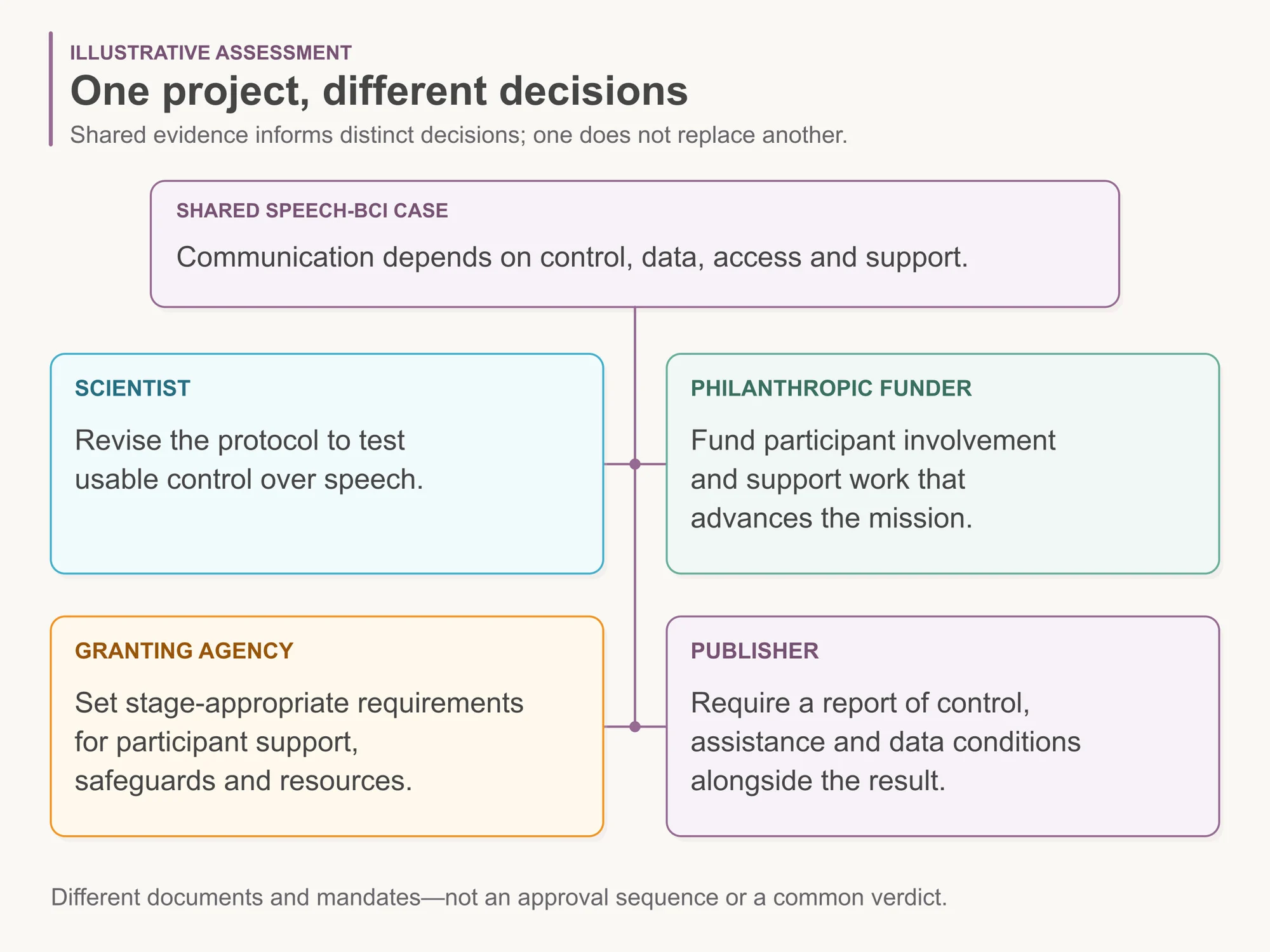
For a scientist, this finding opens questions about what to investigate next. For a foundation or grant agency, it may justify considering a request to support further research. For an editor, the question is what the completed study contributes to scientific knowledge. All can recognise the achievement without reaching the same conclusion about the next step.
Their judgments become more useful when the reasons are clear. A research team needs to know which uncertainty calls for a new experiment, which part of its design needs changing and which commitments a funder requires before supporting it. Readers of a paper need to understand what the evidence establishes and under what conditions. Following the intended benefit through those conditions gives each person a more concrete basis for deciding what to do.
Begin with the decision the evidence must support
To make this concrete, consider an illustrative follow-on project seeking funding to study an implanted speech BCI in additional adults with ALS who retain some speech function.
The project’s long-term ambition is dependable communication in daily life. Its immediate request is funding for a further research study, not permission for routine clinical use. In this hypothetical design, the decoder adapts to the participant, the research-site team provides technical assistance, and that assistance is budgeted for the study period. The team proposes appropriate measures of communication and is explicit about what remains unproven.
Even so, consequential choices remain open:
- The scientists must decide how participants will control changing decoder output
- The host institution needs to establish what support and withdrawal arrangements it can commit to.
- A foundation concerned with communication access needs to understand what the proposed work could contribute for people who cannot regularly reach a specialist research team
These questions could change the study design, its budget and the case for funding it.
Start, then, by identifying the document and the decision in front of you. When scientists examine a research plan, they are deciding whether the proposed methods can answer a worthwhile question and what needs to change before the study proceeds. When a foundation or grant panel examines an application, it is considering whether the proposed contribution merits support under a particular programme, with its objectives, resources and conditions. When editors and reviewers examine a manuscript, they are judging the reported work against the journal’s standards.
These decisions can draw on some of the same evidence, but a research plan, a grant request and a manuscript describe different things at different times. A promise in an application is not evidence that the promised work happened. A published result is not a commitment to maintain a participant’s system. Naming the document, its version and the decision prevents a project’s general reputation from standing in for the reasons to support this particular next step.

Examine what makes the benefit possible
For the scientists developing our hypothetical study, the next question is what it would mean for a participant to regain communication. Accurate decoding matters, but so does being able to decide when to speak, correct an unwanted output and stop using the system. Examining the proposed interface therefore means looking at how it supports those abilities, including when the decoder makes an error or changes after an update.
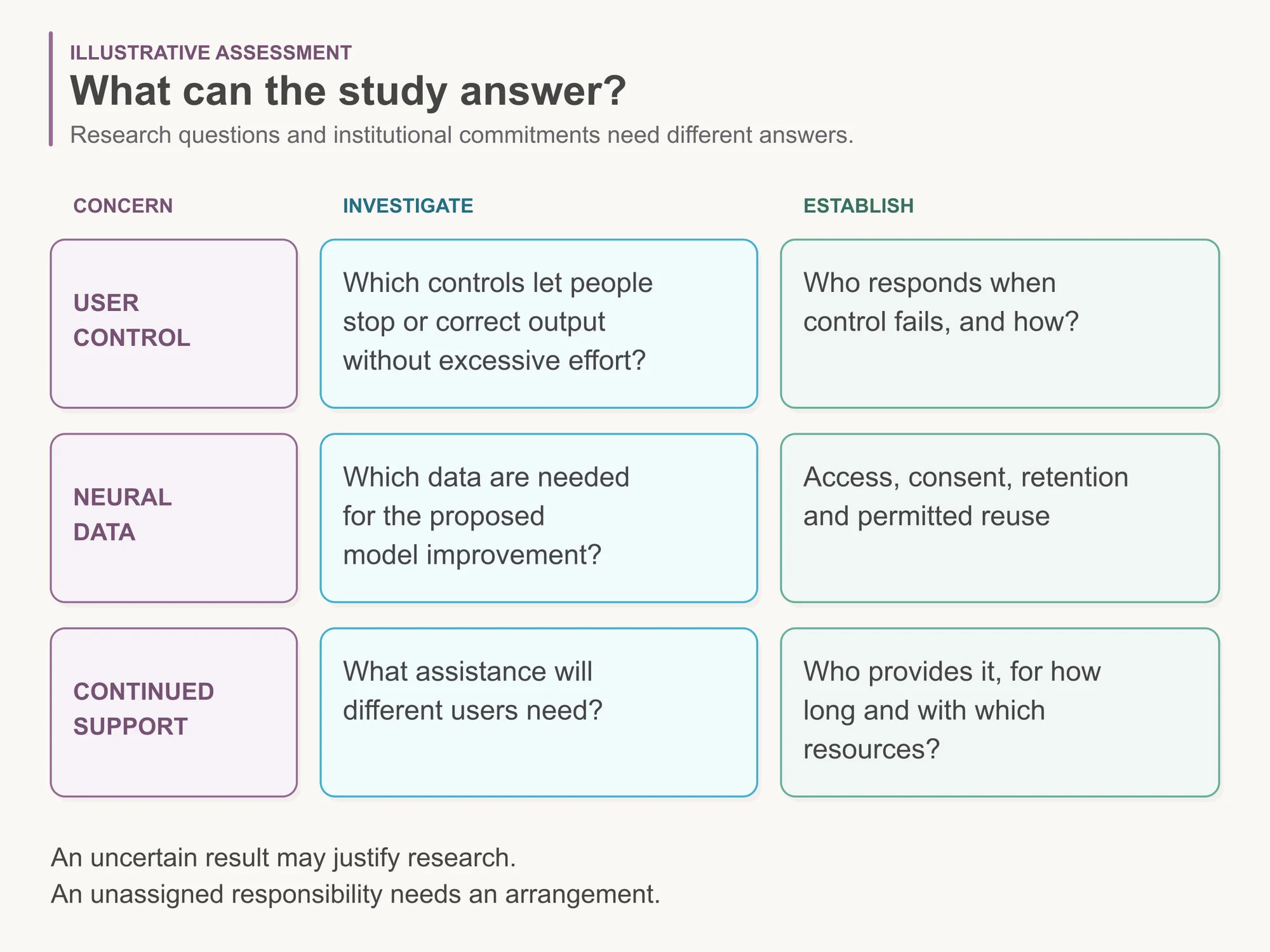
The team is considering a confirmation step before decoded text is spoken aloud. That could give the participant more control over an incorrect message, but requiring confirmation too often could make conversation slower or more demanding. Neither "maximise accuracy" nor "keep a human in control" resolves that design choice. The researchers need to investigate which controls people can actually use, how much effort those controls require and what should happen when they fail. People who might use the system need to help define what an acceptable arrangement would be.
The data plan deserves the same specificity. To judge whether it is appropriate for the proposed study, the team and those reviewing the protocol need to know what is collected, where it is processed, who can access it and what further uses are permitted. Improving a model with participant data raises questions beyond the immediate act of helping that participant communicate. Consent, retention, access and future reuse need to be considered separately rather than absorbed into a general claim that the system is beneficial.
Support creates another dependency. The hypothetical grant pays the research team to maintain the system during the study. If a participant finds it useful, the end of the grant does not by itself settle what should happen next. Before committing to the study, the team and host institution need to establish who can maintain the equipment and software, what continued access can realistically be offered, and what clinically appropriate withdrawal or end-of-support arrangements would involve. The funder needs to see which of those commitments its award would cover. An intention to help later is different from an arrangement with an accountable institution and resources behind it.
These conditions also determine who could benefit. Frequent travel, an available helper or technical assistance that only one centre provides may make participation possible for some people and difficult for others. A small early study need not solve every future access problem. But its researchers should identify those dependencies when choosing participants, interpreting their findings and proposing the next study. Otherwise, an arrangement that worked in one setting can quietly become the model for a service others cannot use.
Looking at the whole arrangement changes what counts as an improvement. A more accurate decoder may be valuable; so may a control that people find easier to use, a less demanding support model or a way for previously excluded people to participate. Scientists and funders need this wider view to decide which improvement is worth pursuing next.

Turn a concern into work that can be done
"Consider autonomy" gives the research team little to work with. A colleague examining the proposed interface could instead ask how the study will establish whether participants can recognise, correct or stop unintended output. That question can change the interface, the observations collected and the expertise needed. The appropriate controls remain a matter for investigation with participants and the relevant clinical and technical specialists.
"Protect neural data" becomes a request for a data-flow account and specific access, retention and reuse arrangements. "Provide long-term support" becomes a request to identify the responsible organisations, the scope and duration of their commitments, the resources available and the arrangements if continued use is no longer possible. Each concern now points to something the team can investigate, revise or agree with another organisation.
The distinction between those responses matters. How well a particular confirmation method will work may be an appropriate subject of the study. Who is responsible for responding to a participant’s need for help cannot simply be left for the results to reveal. Similarly, affordability at a future scale may remain uncertain while the immediate costs of participant support need a credible arrangement before recruitment. A research uncertainty calls for a way to learn; an unresolved obligation calls for someone able to take responsibility.
Grant reviewers already examine parts of this reasoning. Under its simplified review framework for most research-project grants, the US National Institutes of Health considers the importance of the proposed research, its rigor and feasibility, and the sufficiency of expertise and resources. Its guidance allows uncertainty about feasibility to be weighed against the potential for a major advance. A study need not have a predictable outcome to make a credible case for support.
For our example research team, the practical task is to show how each important question will be answered and which arrangements will already be in place. The participants, measures, comparison and analysis must fit the question being investigated. The support plan must identify how participants’ needs will be met. Putting these elements together helps the team design a study that can produce useful knowledge without treating every unknown as either a reason to stop or a detail to leave until later.
Make the case for funding explicit
A philanthropic funder may have a particular reason to support this project. A foundation concerned with communication access might value work on people poorly served by existing options. Another might prioritise a new scientific capability or a shared research resource. Their missions change the contribution they seek from an award; they do not change what the existing evidence establishes.
Those ambitions still need a credible research plan. Wellcome’s Discovery Awards, for example, seek bold, creative research while requiring a clear design supported by evidence and feasible proposed outputs (this is one scheme’s approach, not a universal description of foundations). It illustrates how a funder can seek a substantial advance while examining carefully whether the proposed work could deliver it.
For the hypothetical speech project, a foundation concerned with communication access might decide that the most useful next contribution is evidence about usable control and the support needed to sustain it. That could justify paying for participant involvement, accessible evaluation methods and technical-support work alongside improvements to decoding. Examining how the intended benefit would become possible changes what the foundation considers worth funding.
Limited funds still require a choice. For a programme able to support either route, would enrolling additional participants immediately produce more useful knowledge than first refining the control methods and establishing the support arrangements? A preparatory award might strengthen a later study. The larger study might be justified if these elements are already adequate. The funding recommendation should explain that choice in relation to the programme’s objectives and the application’s evidence, rather than assume that a larger study is always the next advance.
A granting agency may also find that the same support or inclusion question appears across several applications. Where its remit permits, it could consider funding comparable methods or shared research on groups missing from the evidence. In that case, the agency would be deciding how to strengthen the knowledge available across a field, as well as which individual projects to support.
The uncertainties in an application have different consequences for these choices. A funder may be willing to support a study whose performance outcome is uncertain while requiring a definite arrangement for participant support. Expected benefit, confidence in that benefit and the burdens of participation need separate consideration. Strong performance cannot compensate for every unresolved obligation, and a funding award does not replace the clinical and ethical review needed before people participate.
A constructive funding condition should therefore name the required change, the person or organisation responsible and how completion will be judged. "Address long-term support" is too vague to guide either the recipient or the funder. Asking the host institution to specify the support it will provide, for how long and with what resources gives both parties something concrete to resolve before the relevant stage of research begins.
Publish the conditions as well as the result
Later, a manuscript would put a different decision before publication editors and reviewers: does the reported study make a contribution that meets this journal’s standards? A funding case can justify investigating a possibility, but a paper reporting the results must account for what was actually done and observed.
For our hypothetical study, an editor would need to examine more than a headline accuracy figure. The paper should make it possible to understand the user’s control over output, how decoder changes were handled, what technical help was available and which participants and settings were represented. Relevant consent and oversight information, data provenance and reuse restrictions also belong in the account. A later reader needs to know which parts of the achievement depended on those arrangements.
This does not mean a journal must require an early study to have solved the future delivery of a service. A valid result can be worth publishing while long-term access remains unresolved. The editor’s task is to judge whether the paper reports the findings and their limitations adequately, under the journal’s standards. Requiring that account cannot substitute for the host institution making its own support commitments.
PLOS One, for example, requires conclusions to be supported by the data and considers negative or null findings. Its policy offers a clear expression of a useful principle: a result does not need to confirm the desired outcome to add to scientific understanding. Journals differ in scope and selection criteria, so a recommendation to publish must still explain how the manuscript meets the standards of the intended publication.
Nature offers another concrete example through its data-availability requirements. Authors must explain how the data needed to interpret and verify their findings can be accessed. Where access is controlled, the policy asks them to state why, how requests are handled and what restrictions apply to reuse. For our speech-BCI paper, this would mean explaining what supporting neural data other researchers could examine, under which permissions and protections. Readers need to know how the result can be checked, including where participant privacy limits access.
There are also methods that bring part of this scrutiny forward. In the publication format known as Registered Reports, reviewers assess the research question and methods before the outcomes are known. In-principle acceptance is independent of the outcomes, subject to the relevant protocol, quality and reporting requirements. Where the format suits the research, it makes the value of answering the question explicit before anyone knows the answer.
For scientists planning what to investigate and report, the conditions of benefit can therefore be part of the scientific contribution. Learning that a control is too demanding, that support needs differ between users or that an arrangement excludes people can guide the next design. Those findings should remain visible even when technical performance is impressive.
Write a conclusion that someone can act on
By this point, calling the proposed study "promising, with moderate uncertainty" would discard much of the useful reasoning. A recommendation to a funder needs to explain which work deserves support, why it is worth doing and what needs to be resolved before the award can cover the next stage.
For our illustrative proposal, that recommendation might read:
The communication goal fits this programme. Offer a preparatory award to investigate usable control over decoded speech with prospective users and to establish the data and support arrangements for a further study. Before funding additional enrolment, require a revised protocol and independent review of the relevant safeguards, together with named institutional commitments and resources for participant support and withdrawal. Base the next funding decision on evidence about communication, control and assistance needs, alongside the programme’s scientific criteria. Broader access remains an objective to investigate, not an outcome established by the present evidence.
This example shows how to give the scientists a basis for revising their plan and the funder a basis for defining its commitment. An editor considering a later manuscript would need a different conclusion, tied to the completed study and the claims its results support.
Disagreement should be equally specific. Two grant reviewers may accept the same evidence but differ over whether the anticipated benefit warrants the proposed burden, or whether the likely knowledge gain fits the funding mission. Recording those reasons alongside any score helps distinguish a disagreement about facts from a disagreement about priorities. It also tells the applicant what a revision could — and could not — resolve.
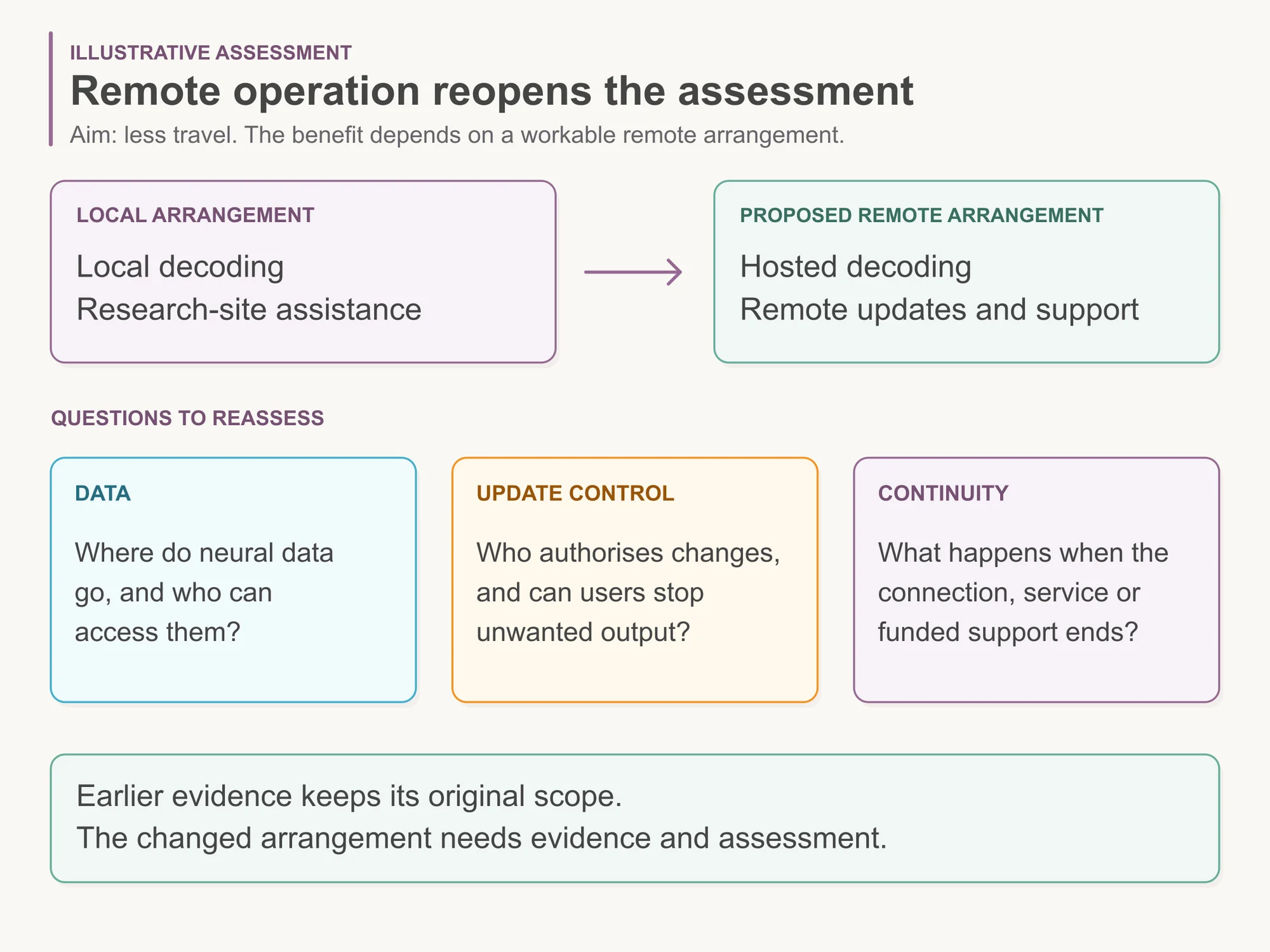
Now the hypothetical team proposes remote operation to reduce travel to the research site. In this version of the plan, it would move decoding from a local computer to a hosted service and provide software updates remotely. This could make participation possible for people who find repeated visits difficult. It would also change where neural data travel, who controls updates and what happens when the connection or service is unavailable.
The earlier communication result remains valuable, but it does not establish how well this new arrangement would work. The researchers need to reconsider their design and the evidence needed about remote use. The funder needs to examine the revised costs, service dependencies and support commitments before deciding whether to support the change. A later paper would need to describe the conditions under which the remotely operated system was studied. A change intended to improve access can create new conditions for achieving it.
This is why the reasons behind a decision need to remain available after it is made. If the original award depended on research-site assistance, changing that assistance changes something the funder relied on. If a published result depended on local operation, readers need to see that boundary when using it to justify a new study. The benefit being pursued may stay the same while the evidence and commitments needed to pursue it change.
How to keep the whole picture in view
A careful team can examine a research plan through meetings, papers, and annotated documents. A funder can explain an award in a decision letter; an editor can explain requested revisions in a review. The difficulty grows when the underlying arrangement changes and people need to understand what that means for their own decisions. In our example, remote operation affects access, data protection, user control, technical support and the funding case at once. Keeping those connections usable requires more than storing the documents in the same place.
Keeping the whole picture in view as research evolves calls for a digital platform designed around the connections between evidence, design choices and responsibilities. In our speech-BCI example, the proposed move to remote operation could be examined alongside the data flows it changes, the support it requires and the funding commitments it affects. Scientists could identify what needs testing; funders could see what their support would need to cover; editors could trace a reported result back to the conditions that made it possible. Each would have a view suited to their decision, with access to the relevant supporting evidence.
The platform needs to preserve the difference between evidence already available, research proposed to obtain more evidence and a commitment an institution has actually made. The original research result would keep its stated conditions. A new plan would remain distinguishable from work already completed. A blank answer about support must remain distinguishable from a confirmed lack of support; naming an organisation must not imply that it has agreed to take responsibility.
These different views need appropriate access boundaries. An editor or reviewer needs the evidence and disclosures relevant to the manuscript, not unrestricted access to a confidential grant file. People contributing their experience need an understandable account of how their views are represented and a way to correct it. Connected information can serve these distinct tasks without turning them into one institutional verdict.
Confidential proposals, participant information and peer-review material must remain protected. Sources and summaries need human curation; suggested questions need expert judgment; the people affected need a genuine opportunity to influence the work. Each institution retains its authority and obligations.

A well-designed digital platform makes this complexity manageable without hiding it. It enables people to examine their part of the research while keeping its dependencies and, most importantly, the person meant to benefit in view.